Uncategorized

Background of this work

In 1962 Harry Hess made a big contribution by showing the importance of mid ocean ridges in Earth’s geology. At the same time he put forward his idea about convection current system:

Hess, Harry. „History of Ocean Basins.“ Petrologic studies: a volume in honor of A. F. Buddington Geological Society of America (1962): 599-620.

Basics Hess

This picture drawn by Harry Hess, if taken accurately, gives 8 large convection cells around the globe.

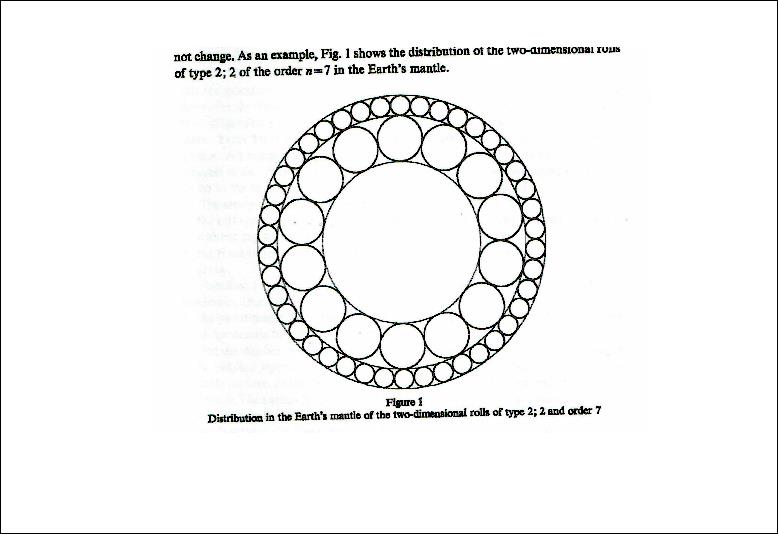
In 1971 Uwe Walzer wrote an article showing that convection cells within the earth must be as regular as possible. He explained the preconditions for for this conclusion and searched systematically for a solution.

WALZER, UWE. 1971. Pure and Applied Geophysics Volume 87, Number 1, 73-92, DOI: 10.1007/BF00878910
Basics Waltzer

This drawing by Waltzer has 14 large mantle currents.

With additional information available since the times around 1960-1970, I found the large convection cells to be 12, not 8 or 14! And with the help of a few laws of physics, geology of Iceland suddenly seems so much more simple to understand!

The logo of this site shows the slightly different pattern:

cropped-logo-magicmagma-core-mantle-crust1.jpg

With the 240 smaller cells side by side under the crust and by referring to the Coriolis Effect (different angular velocity for each latitude), the 3D model was completed.

It can be used right away to answer a million questions!


Uncategorized

Beerenberg in Jan Mayen

Beerenberg in Jan Mayen is in the line of the Eastern Volcanic Zone of Iceland! It has to be calculated with the formula for the polar system of convection cells. It looks like that:

Basics Beerenberg

Looks complex? It is not, because you do not need the formula to see how the famous Laki is in the same line as Beerenberg. The same convection cells are at work underneath both volcanic sites! The location of the volcanic sites can be explained by referring to the convection rolls of the mantle.

Uncategorized

Searching for geothermal heat

It is a step forward to be able to calculate the alignment of the mantle convection cells underneath the crust, and thereby knowing how force is exerted on the tectonic plates from down below. The basics tectonic features of Iceland and many other areas follow the formulas very accurately. I participated in a search for geothermal heat at Skógarströnd of the Snæfellsnes Peninsula, and geothermal heat was found at the farm of Innra-Leiti. The borehole was about 1 km deep and hot water was actually found there and registered. Two faults did cross each other at the location of the borehole, providing the necessary flow of water. Dr. Haukur Jóhannesson decided the exact location of the drilling site. Both faults did fit into the convection cell formula, and therefore the site was considered more convincing. Knowledge is to be utilized!

Uncategorized

The Reykjanes Ridge

I feel like we underestimate the importance of the Reykjanes Ridge when dealing with the geology of Iceland. Look at that big feature! Most important is found above the convection rolls!

The basics of the Reykjanes Ridge can be described in a very simple way. To make it clear, let us have a look at this drawing of convection rolls with a Google map with division lines added:

Reykjanes 02

The SW corner of Iceland can be seen. The Reykjanes Ridge ends there. Instead volcanic systems are found en echelon along the Reykjanes Peninsula.

The Reykjanes Ridge is the most typical feature to begin studying the convection cell system. Two convection rolls, forming one pair of upwelling, creating a distinct feature of a Mid Ocean Ridge. The alignment of the ridge fits perfectly to the calculations made according to the Coriolis Force acting on mantle material flowing slowly under perfectly balanced conditions.


Uncategorized

Mystery of Hekla and Trondheim area

Compare in Google maps Hekla and its counterpart 30° to the East. Why? Because the same convection cell pattern is found under the tectonic plates at 30° interval on the same latitude. Find the correct spot in Norway and compare to Hekla. The pictures look strikingly similar! Still, Norway is geologically not similar to Iceland at all. How can this be?

Basics - Hekla - Norway

Hekla and Trondheim area – 30° of longitude apart compared

All this can easily be explained. So join the club!