Uncategorized

Iceland and Bering Strait compared – why copy paste?

Comparing the Icelandic West Fjords with the Bering Strait at the same latitudes, the same orientation of tectonic features appear. And this is the same case as I have already shown in other posts with Scandinavian Peninsula, Greenland and Baffinsland at the same latitudes! When information like this has been gathered, and it can be manifested again and again, it becomes a proof that a systematic convection cell system is affecting the tectonics above:

Bering Strait compared with West Fjords

The black straight line is the alignment of convection rolls extending from the pole, and the red lines indicate the direction of convection rolls extending to equator.

With a map at hand, using the convection cell model for comparing different areas becomes quite easy.

Uncategorized

Some details of the tectonic framework of Thingvellir in Iceland

One of the most popular sites in Iceland is Thingvellir. Here is a simple drawing of Lake Thingvallavatn, showing the combined tectonic forces that make the area so special:

Thingvallavatn - tectonic framework - 01

As can be seen on this simple drawing, the edge of the Western Volcanic Zone of South Iceland, Hengill Volcanic System and a large scale rift zone combine around the NS-axis of the relevant polygon of convection cells underneath. This results in a very prominent line of cliffs including the famous Almannagjá. A similar combination occurs at Hrafnagjá.

Of course, tectonic drift is responsible for this, but the division line of the large convection cells is found at the eastern edge of the Western Volcanic Zone.

The tectonic directions can be calculated one by one, as explained in an earlier post.

Uncategorized

How the tectonic plates of the continents meet in Iceland and how the mantle flow underneath is divided

When we say that Iceland belongs to two tectonic plates which drift away from each other, we also say that two different mantle currents exist under the country. Well… we usually skip the latter part 🙂 Still it is what we mean by drifting – a current takes the huge plates and moves them! As I have analyzed these currents, we can compare that analysis with the division line between the continents according to drift vectors measured with GPS technology.

Iceland - division lines of lower mantle and tectonic plates

The black line is the division line of the main convection lines of lower mantle. The red line shows the main division line in between the two tectonic plates of N-America and Eurasia. The thin lines show the network of smaller convection roll layers.

To fully comprehend this, one has to read the book first 🙂 But the base is simple – regular convection current rolls with the same height and width – just physics.

Uncategorized

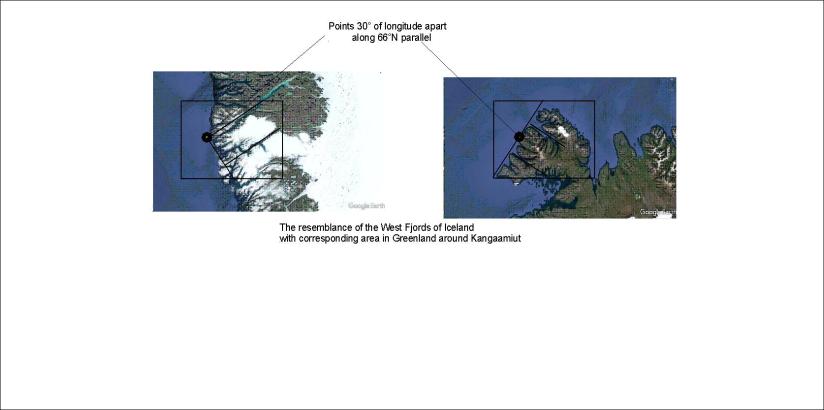
Iceland and Greenland compared – the West Fjords counterpart 30° to the west

If regular convection rolls govern the development of tectonics of the Earth’s crust, we should see comparable formations at regular intervals on the surface. With a model of the convection cell system, this can of course be tested. Let us compare Iceland and Greenland:

West Fjords of Iceland and West Coast of Greenland

The coasts at 66°N are exactly 30° apart, and the tectonics are mirrored so that the West Fjords of Iceland are aligned W34°S, but the fjords of Greenland are aligned W34°N. The main coast line is also mirrored, the West Fjords of Iceland follow the upper most convection cells to the NW (N31.4°E), but the outer coast of Greenland has the direction N31.4°W.

I have formerly compared the West Fjords with the west coast of Norway. The result is always a manyfold match. The interplay of different convection cell layers is apparent. Have in mind that only one basic formula is used for calculating the lines drawn along the coasts and fjords. It is the equation of the convection cell system that explains these repeated tectonic features, which remain hidden until revealed in this way.