Uncategorized

Tjörnes Fracture Zone Double Nature

To be able to analyze the Tjörnes Fracture Zone, first it has to be realized that it extends from Skagafjörður to Skjálfandi, and in the East and West coincides with two different volcanic zones. The western volcanic zone of the North, Skagafjörður Volcanic Belt, is actually neglected by most geologists, because it is volcanically extinct. Still it exists seismically, as shown here.

Tjörnes Fracture Zone within the settings of the active North Volcanic Zone and the extinct Skagafjörður Volcanic Belt.

Recently, many earthquakes occurred at Reykjanes, and now within the Tjörnes Fracture Zone. Here, the convection rolls division line of Reykjanes is pointed out, to show how it divides the TFZ into two areas, east and west of the line. The earthquakes start on the line, and then start spreading along the Kolbeinsey Ridge.

Here I point out: https://agupubs.onlinelibrary.wiley.com/doi/pdf/10.1029/2000TC900022
Uncategorized

Earthquakes Within Tjörnes Fracture Zone

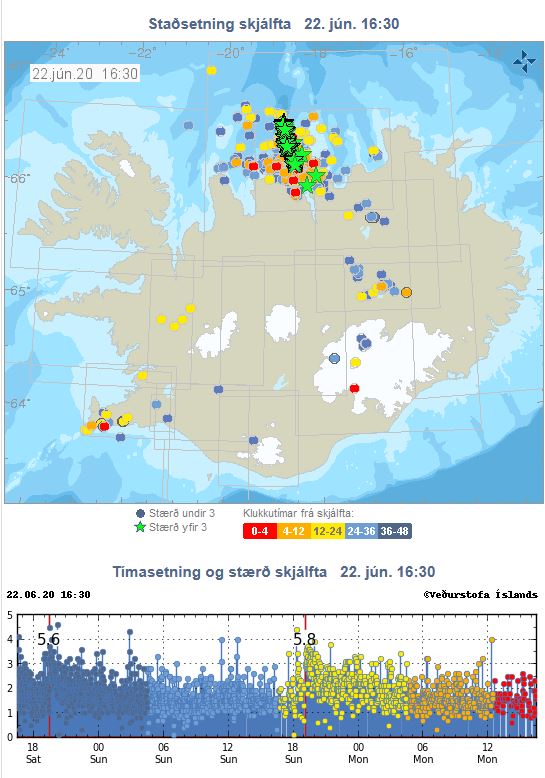
The earthquakes within Tjörnes Fracture Zone are aligned paralell to the convection rolls of polar system.

Earthquakes 22-6-2020.

This can be compared with the convection rolls map:

Comparing Convection Rolls With Earthquakes

https://www.vedur.is/skjalftar-og-eldgos/jardskjalftar/tjornesbrot_stort/

The earthquakes started mainly within the First Polygon, but then spread northwards along the central NS-axis of the Second Polygon shown on the picture above.

Also, it is interesting to see how the earthquakes spread north of Skagafjörður, the old volcanic zone, which has been volcanically extinct for a few hundred thousand years, but is still seismically and geothermally active.

Uncategorized

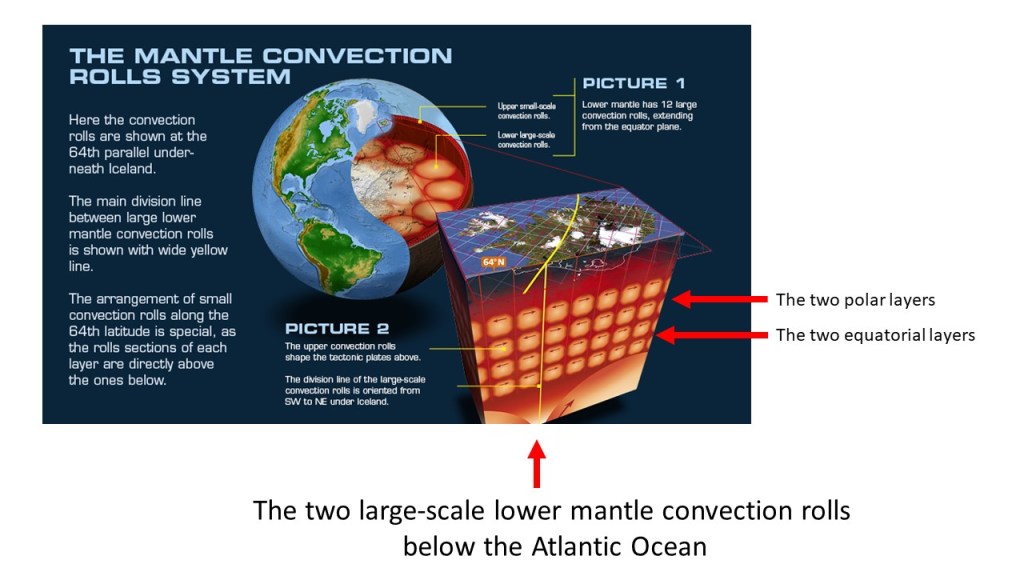
Earth’s Layers and the Convection Rolls

Analyzing the convection within Earth’s mantle is actually very easy. The layers of Earth have been measured, and each of them is a layer of convection. Physics tell us convection of the mantle should be in the form of convection rolls. The shape of the rolls must be in accordance with the shape of the Earth. Thereby we know the basics, and can make use of our knowlegde, understanding the geology better.

Earth’s Layers and the Convecction Rolls

Between the large scale rolls and the tectonic plates, there are two layers. Also, there is a special system for the poles, and a system extending from equator. These system intersect each other, forming a transition zone. The central axis of transition zone is 64°N. The picture above shows the central axis of 64°N. Therefore, there are 4 layers found between the large scale rolls and the tectonic plates.

The two layers from south become the lower convection rolls. The polar system is composed of the upper more convection rolls of the transition zone.

We are so lucky that the weather system follows the same rule. So those who have studied meteorolgy might see the analogy. here. Southern winds along the ground rise and head back. Northern winds also rise and find their way back. The result of the transition is also four layers, exactly at the same latitudes.

Uncategorized

Reykjanes Ridge of Equator Convection Rolls System, and Convection Rolls of Polar Rolls System Connected

The Reykjanes Ridge is mainly shaped by the equatorial system of convection rolls, but the direction shifts when the polar convection rolls system takes over within the transition zone at the latitudes where Icealnd is located.

Reykjanes Ridge Convection Rolls and Connection With Polar Convection Rolls

It must be remembered, that the main division line is actually 1.5° farther to the East, where the division between large lower mantle convection rolls is found.

Uncategorized

Reykjanes Ridge Prolonged North of 64°N

The Reykjanes Ridge and Kolbeinsey Ridge form a rather regular division line between tectonic plates, south and north of Iceland. In between the pattern is more complex. As for the convection rolls below, they are in a way more complex under Iceland, due to the transit zone of polar and equatorial convection rolls.

The two systems meet at 64°N, and both are subject to the same mathematical formula. If we trace the Reykjanes Ridge Convection Rolls, we find this picture:

Reykjanes Ridge Convection Rolls Prolonged