Blog

Uncategorized

Geothermal Resources and Mantle Convection at the World Geothermal Congress in Reykjavik 2020+1

To introduce the model of convection rolls and how it explains the existence and distribution of geothermal resources in Iceland, I take part in the World Geothermal Congress held in Reykjavik this year (2021). The model should better have been developed in the nineteenth century when it was realized that land mass is regularly distributed along equator, and that must be for a reason. Someone should have considered that the span of the Atlantic Ocean and the Indian Ocean of 60° represented two large convecction cells, and the mainland of S-America, Africa and Indonesia span 30°, did show the location of a single large scale convection cell underneath. But no one did, so this became a debate finding place within the twentyfirst century! Harry Hess https://en.wikipedia.org/wiki/Harry_Hammond_Hess was on the correct track in 1962 with the article ´History of Ocean Basins´. Further development effort by the scientific community of his theory would have made this website obsolete. But my video about geothermal resources is found here, meant to bring us all one step closer to the ‘correct track’ again: https://wgc2020-virtual2.velkomin.is/login?redirect=/event/13040

The abstract is found on the website of WGC: https://pangea.stanford.edu/ERE/db/WGC/Schedule.php?SlotDay=4

Realizing that convection takes place within the mantle is easy and acknowledged by virtually everyone engaged in geoscience. The convection pattern, on the other hand, was a bit hard to derive. Now it has all been clarified and shown to everyone. The starting point is obvious enough to be 100% convincing, namely the fact that convection rolls with height to width ration 1:1 clearly fit exactly within the equatorial plane. The rest has to be found out, step by step, with the help of some knowledge about physics. You have to consider that the Earth rotates, that the mantle convects, and the constraints resulting from the geoid shape. Then you find out the exact dimensions, shape and location of the convection rolls within the Earth.
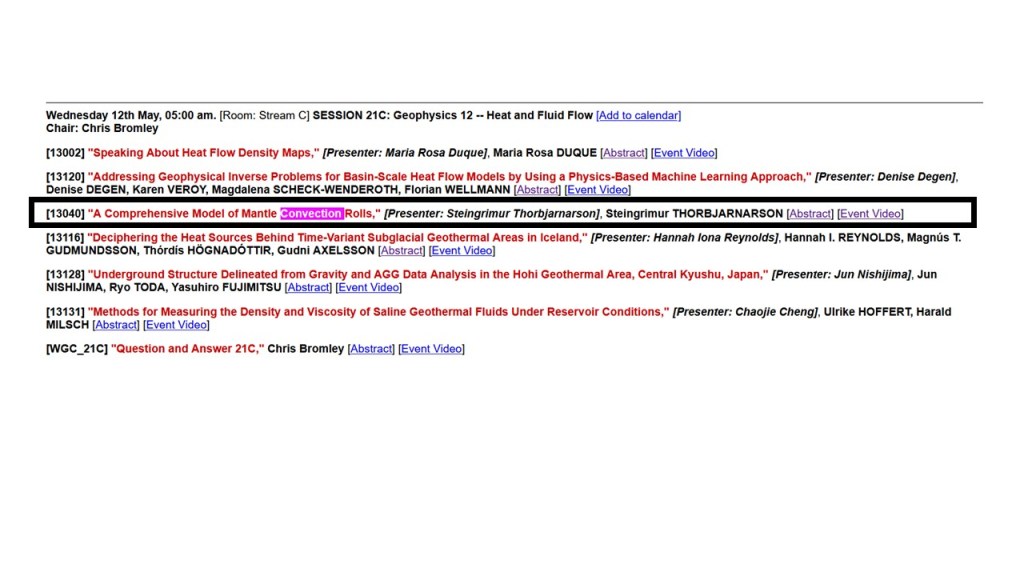
Schedule of WGC with the video ‘A Comprehensive Model of Mantle Convection Rolls’. https://pangea.stanford.edu/ERE/db/WGC/Schedule.php?SlotDay=4
Uncategorized

Basics of Tectonic Drift

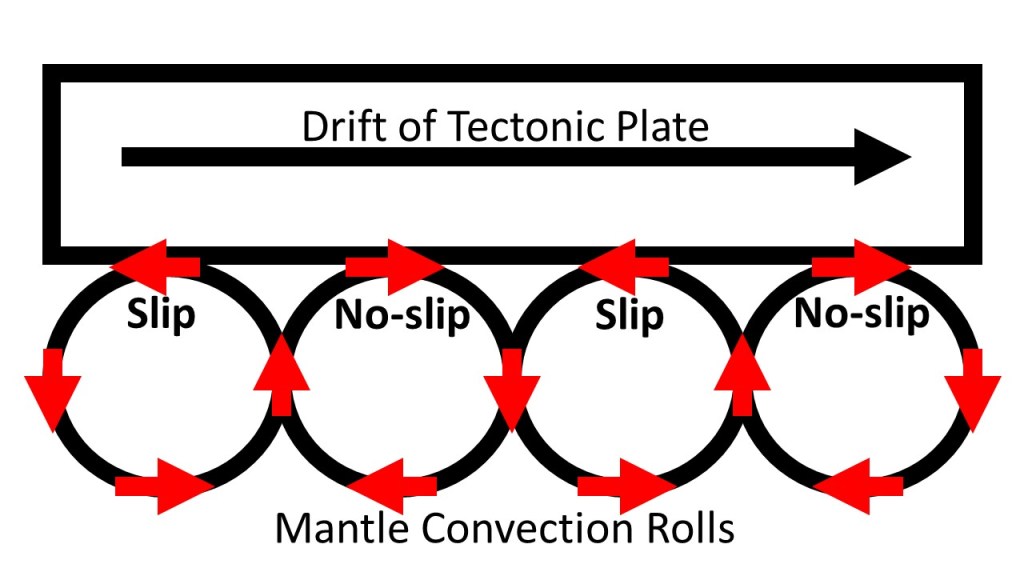
Tectonic drift has to be powered with convection currents. The currents do not work against each other due to slip and no-slip conditions. When a tectonic plate has started drifting into a certain directions, those convection rolls rolling with it also connect with it firmly, but those rolling the opposite way loose the grip. This is due to the fact that the mantle is very close to melting point, so extra friction causes melting, but less friction causes solidation.

Slip and No-slip resulting in tectonic drift.

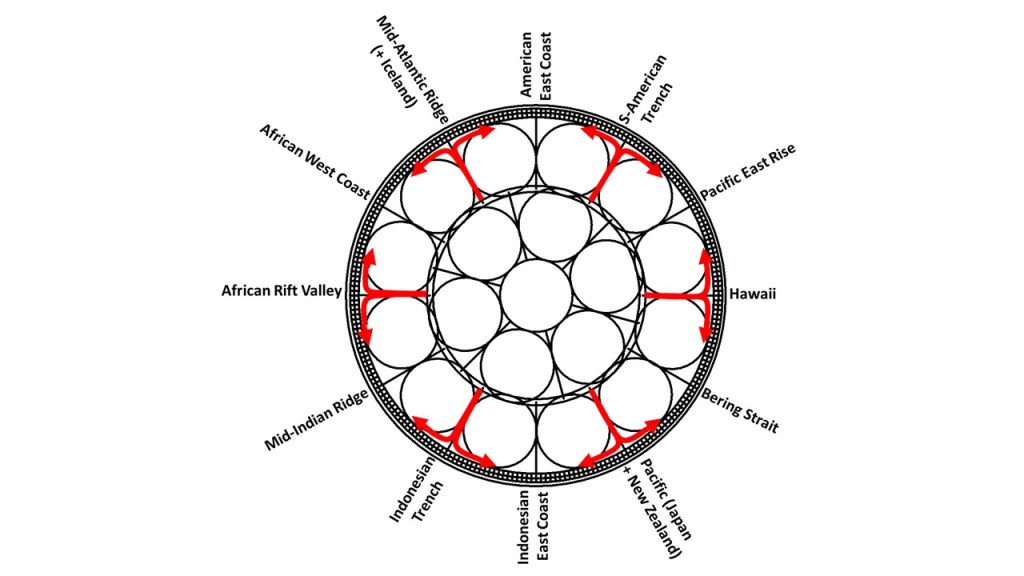
The large scale and small scale convection rolls then work together according to this picture:

Main points of main convection rolls division lines.

The small convection rolls found below the tectonic rolls therefore play a big role in inducing the tectonic drift.

Uncategorized

Why the Eruption of Reykjanes Ridge Brings Magma of the Kolbeinsey Ridge

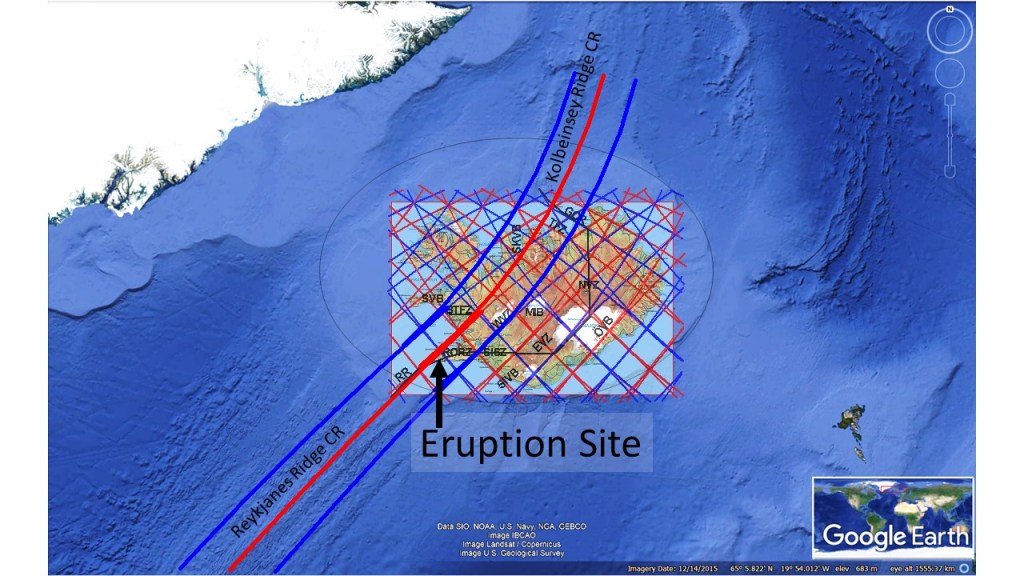
We relate the Reykjanes Peninsula to the Reykjanes Ridge. It is so obvious that the peninsula is a continuation of this part of the huge Mid-Ocean Ridge of the Atlantic. But looking below the crust, things become somewhat different. The convection rolls of Reykjanes are subducted by the Kolbeinsey Ridge Convection Rolls, and therefore the magma now flowing as lava at Fagradalsfjall is not the same as that of the main part of the Reykjanes Ridge.

SS

The subduction can be shown graphically as here below:

The two systems of convection rolls intersect between 60.7°N and 67.3°N, and the northern rolls are found over the southern ones.

Uncategorized

The Turn of the Dike of Fagradalsfjall in Iceland

The dike of the eruption site of Fagradalsfjall makes a turn that must be explained. The magma found its way from the vicinity of Keilir and propagated SW towards Fagradalsfjall. Then it made a turn directly south, just to make a turn again farther south in the same direction as before. All this is in harmony with the magical shape of Fagradalsfjall. It is actually diamond-shaped, about 3.5 kilometers on each side. The deviation from north is the same for all sides, and the alignment is accurately the calculated value for convection rolls.

The dike of Fagradalsfjall, responsible for Geldingadalir eruption. Map from the University of Iceland inserted, showing the predicted dike location.

The mountain clearly has a NS-axis, and almost as clearly an EW-axis, although the westernmost corner is missing. The sides have the same alignment as the dike, and it makes a turn apparently where it meets with the EW-axis of the mountain. The NS-direction of the dike can be explained with the existence of NS-oriented earthquake faults in the area. Farther south, the dike again propagates along the SE-side of the mountain, as large faults are found there aligned NE-SW.

Uncategorized

E-W Trend of Faults on Ocean Floor – for a Reason

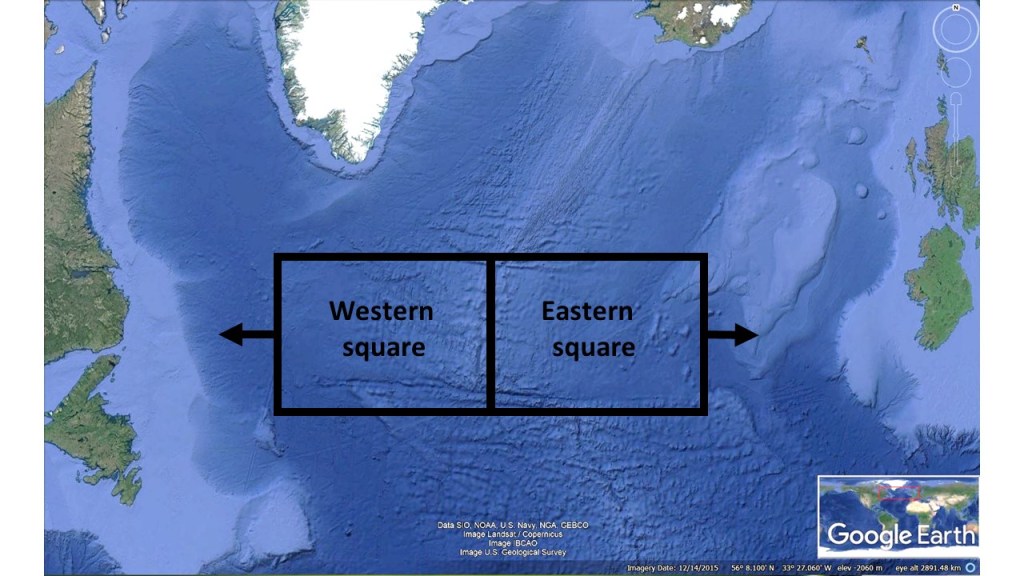
Reasoning the obvious: There are E-W trending faults on the ocean floor all around the globe. Here is an example from the North Atlantic. The reason is simple, namely the way material breaks up due to the forces around, and in this case the forces are regulated by the effect of Earth’s rotation. The flow of magma, and thereby the mantle convection rolls have to sway accordingly, and northwards horizontal flow has to be symmetric to southwards horizontal flow. The result is a mantle pattern symmetry along N-S and E-W axis, and therefore these structures aligned in the main directions appears quite often.

E-W trend of Central North Atlantic Ocean Floor.

The huge forces creating this pattern should not be underestimated. The convection rolls of lower mantle have created the Atlantic Ocean, slowly but steadily over millions of years. Perhaps this is too big for modern science to investigate properly. We want details and accurate measurement. This is too big to imagine, and how to measure the size and power of it? The answer is that we can not detect the mantle flow with enough accuracy for scientists to provide reasonable results. Therefore, I have chosen an inverse way to decipher the convection rolls system, introduced piece by piece on this website.