
Reasoning the obvious: There are E-W trending faults on the ocean floor all around the globe. Here is an example from the North Atlantic. The reason is simple, namely the way material breaks up due to the forces around, and in this case the forces are regulated by the effect of Earth’s rotation. The flow of magma, and thereby the mantle convection rolls have to sway accordingly, and northwards horizontal flow has to be symmetric to southwards horizontal flow. The result is a mantle pattern symmetry along N-S and E-W axis, and therefore these structures aligned in the main directions appears quite often.
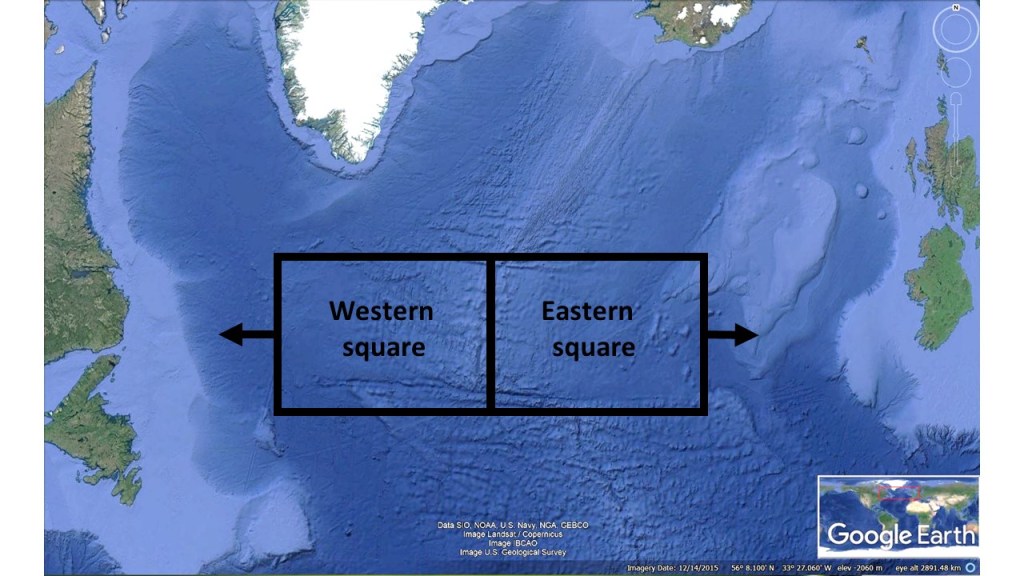
The huge forces creating this pattern should not be underestimated. The convection rolls of lower mantle have created the Atlantic Ocean, slowly but steadily over millions of years. Perhaps this is too big for modern science to investigate properly. We want details and accurate measurement. This is too big to imagine, and how to measure the size and power of it? The answer is that we can not detect the mantle flow with enough accuracy for scientists to provide reasonable results. Therefore, I have chosen an inverse way to decipher the convection rolls system, introduced piece by piece on this website.
Fracture zones on the ocean floor often follow an east–west orientation. One example is the Charlie–Gibbs Fracture Zone. Between this fracture zone and the main section of the Reykjanes Ridge, part of the Mid-Atlantic Ridge runs directly north–south, a trend that also occurs frequently elsewhere.
In this case, two large tectonic domains emerge, both bounded to the south by east–west structures, while the division between them is oriented north–south. On a very large scale, this resembles the same structural pattern observed in Iceland. There, the southern part of the country is characterized by volcanic zones trending northeast–southwest, whereas the northern part contains volcanic zones trending north–south. Both systems are consistent with the structural possibilities provided by the mantle convection pattern beneath them.


