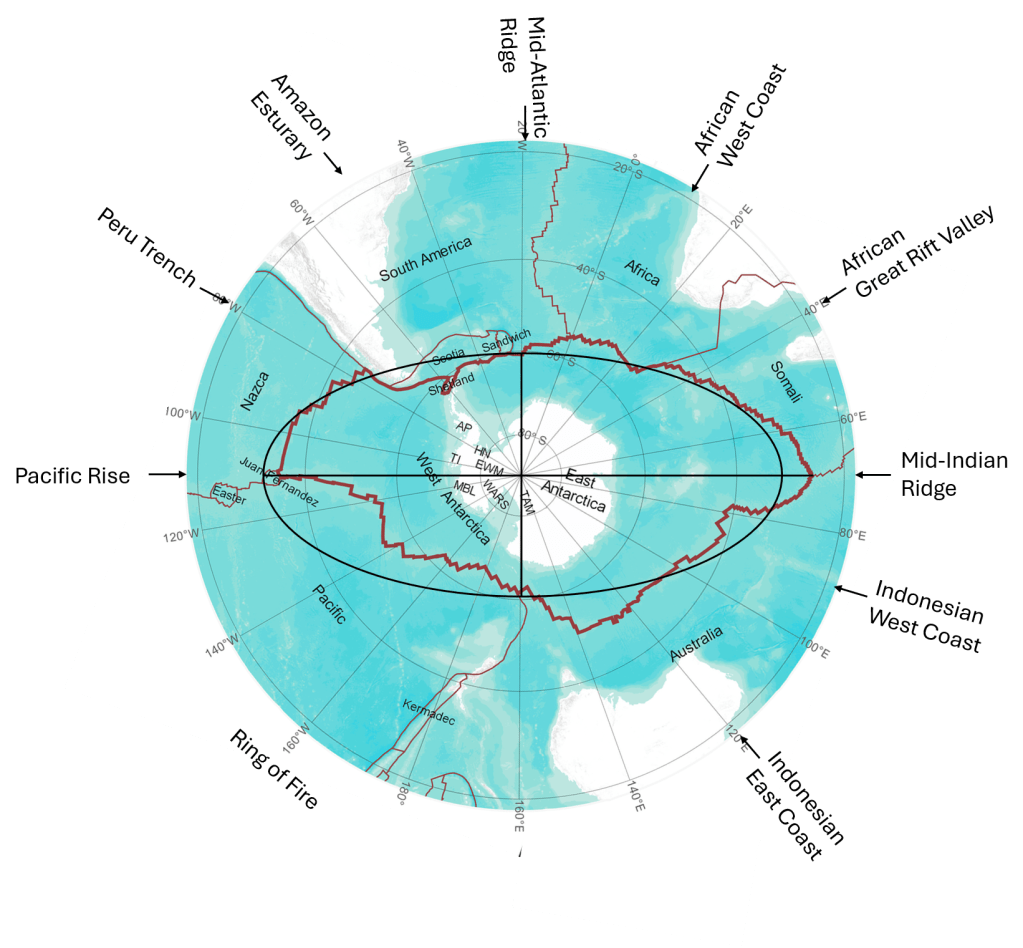
Viewed from the South Pole, the global system of plate boundaries reveals several striking geometric relationships between Antarctica, the Ring of Fire, and Iceland, as shown here:

The following observations summarize these relationships.
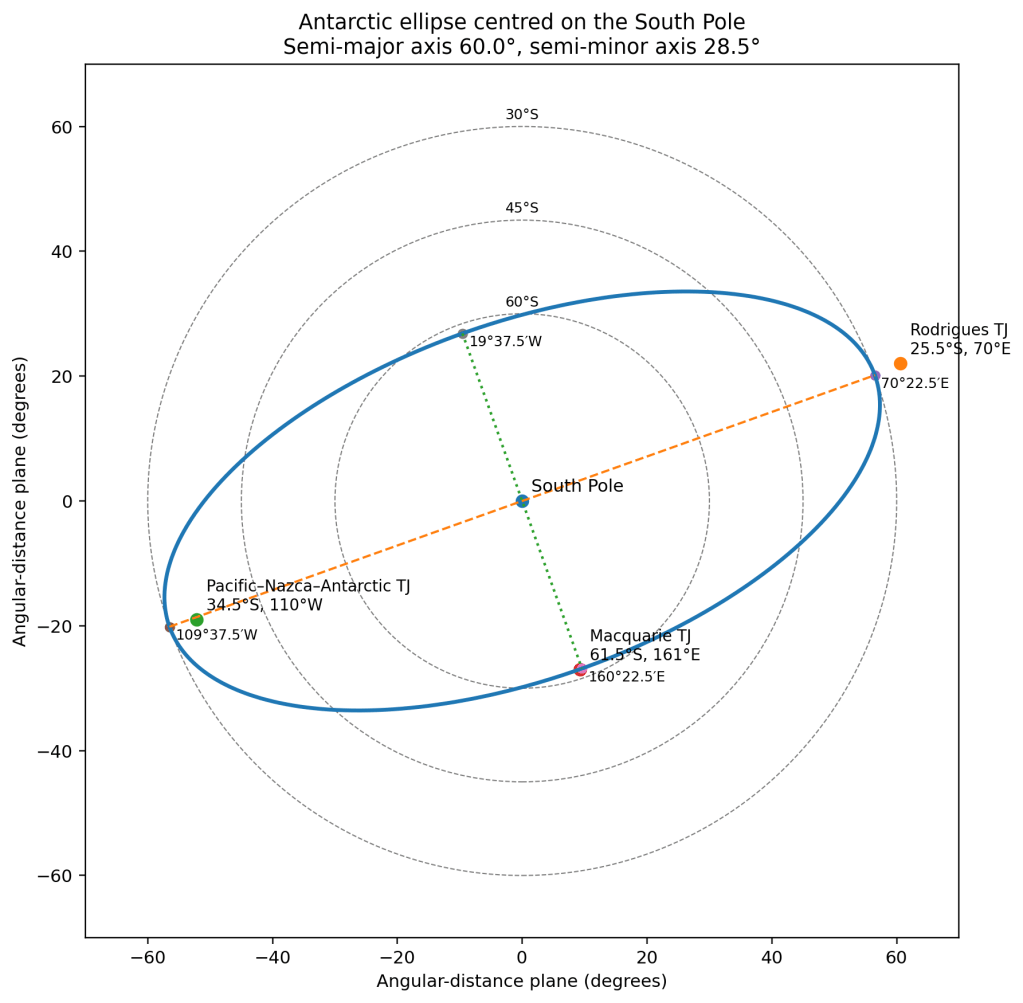
- The Antarctic Plate can be approximated by an elliptical shape. Its minor axis extends from 60°S, 160°22.5′E to 60°S, 19°37.5′W, while its major axis extends from 45°S, 70°22.5′E to 45°S, 109°37.5′W.
- These axes correspond closely with major plate-boundary systems. The major axis aligns with the Mid-Indian Ridge and the East Pacific Rise, whereas the minor axis follows the Mid-Atlantic Ridge and the western Pacific subduction system.
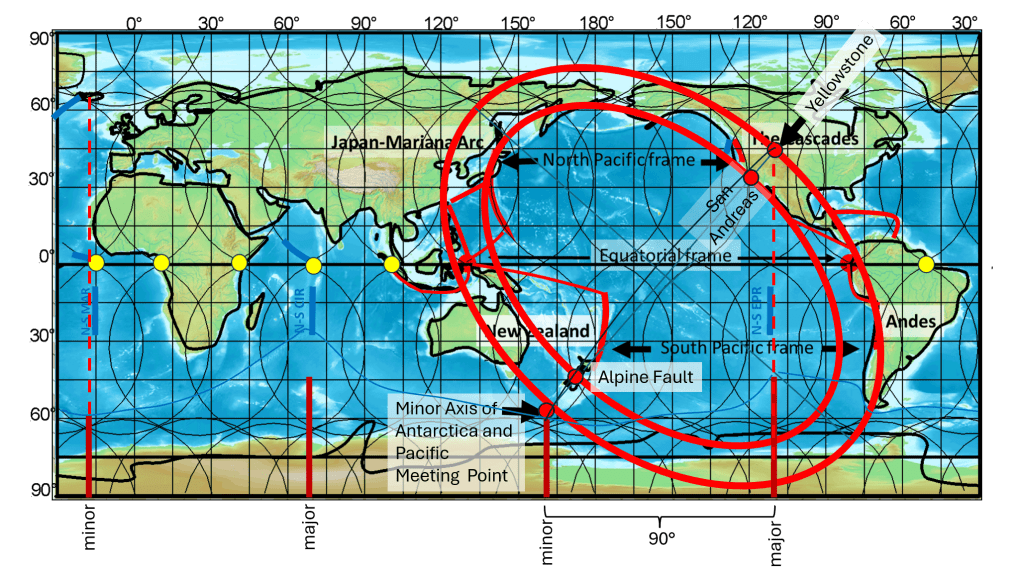
- The Ring of Fire can likewise be represented by an ellipse whose minor axis crosses that of Antarctica at 64°S, 160°22.5′E. The opposite end extends through the equator and is found within the Yellowstone region.
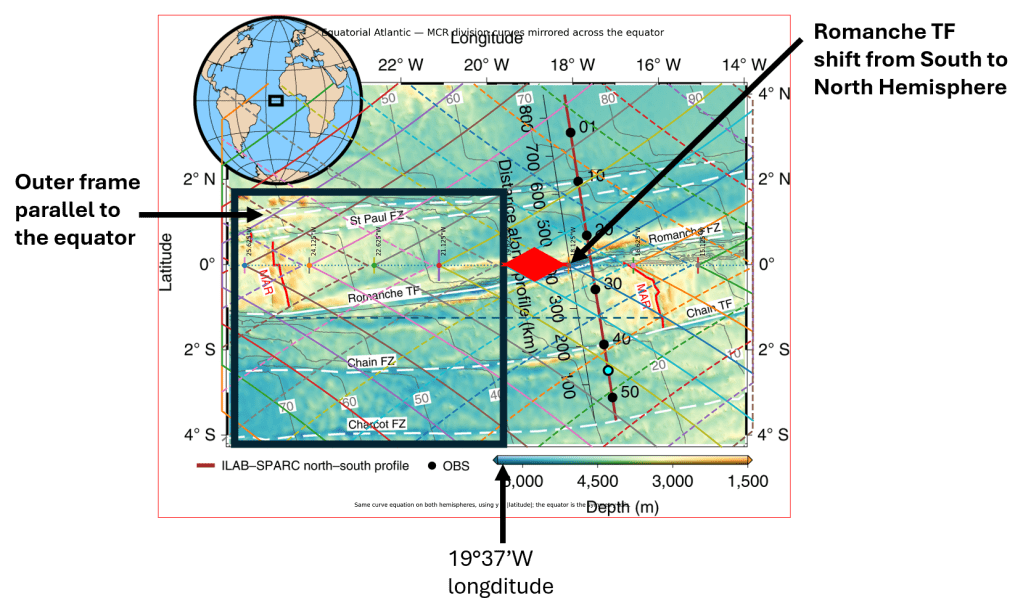
- The south coast of Iceland is located approximately the same angular distance north of the equator as the edge of the Antarctica Tectonic Plate boundary (sea floor) is south of it. Its overall elliptical geometry has the same orientation, with its minor axis lying along the longitude of 19°37.5′W.
- The southern end of the Ring of Fire coincides with the point where an equatorial mantle convection-roll division (red line) reaches the Antarctic Plate. From there, the Antarctic segment of the Ring of Fire continues toward the endpoint of another convection roll (90° apart), where it intersects the Antarctic major axis.
- The resulting geometry is consistent with the Ring of Fire extending between the equatorial convection-roll division points beneath eastern Indonesia and the west coast of South America. It coincides with the main deviation of the elliptical form of the Antarctic Tectonic Plate.
- The illustration is schematic and is not drawn to scale, since it represents relationships on a spherical Earth using a two-dimensional projection.
The purpose of this figure is to illustrate the geometric relationship between the global systems of mid-ocean ridges and subduction zones. In particular, it emphasizes that the Mid-Atlantic Ridge and the western Pacific subduction system occupy opposite sides of the same great-circle plane.
Several important features are intentionally omitted for clarity. These include the subduction system along the west coast of South America, the inner boundary of the Ring of Fire, the San Andreas Fault in California, and the Alpine Fault of New Zealand. Each of these plays an important role in the overall tectonic framework but would unnecessarily complicate the present illustration.
For reference, it may be helpful to compare the upper illustration with the more conventional one below. The Greenland–Iceland–Faroe Ridge Complex (GIFRC) is another manifestation of the symmetry around the 19°37.5′W axis of longi
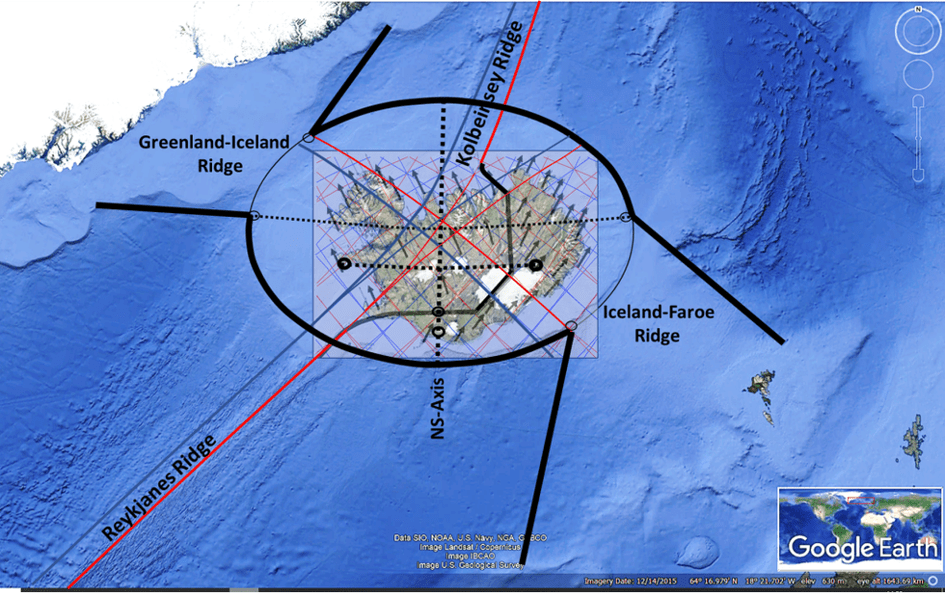
The symmetry around the axis is obvious. A bit more complicated version below:
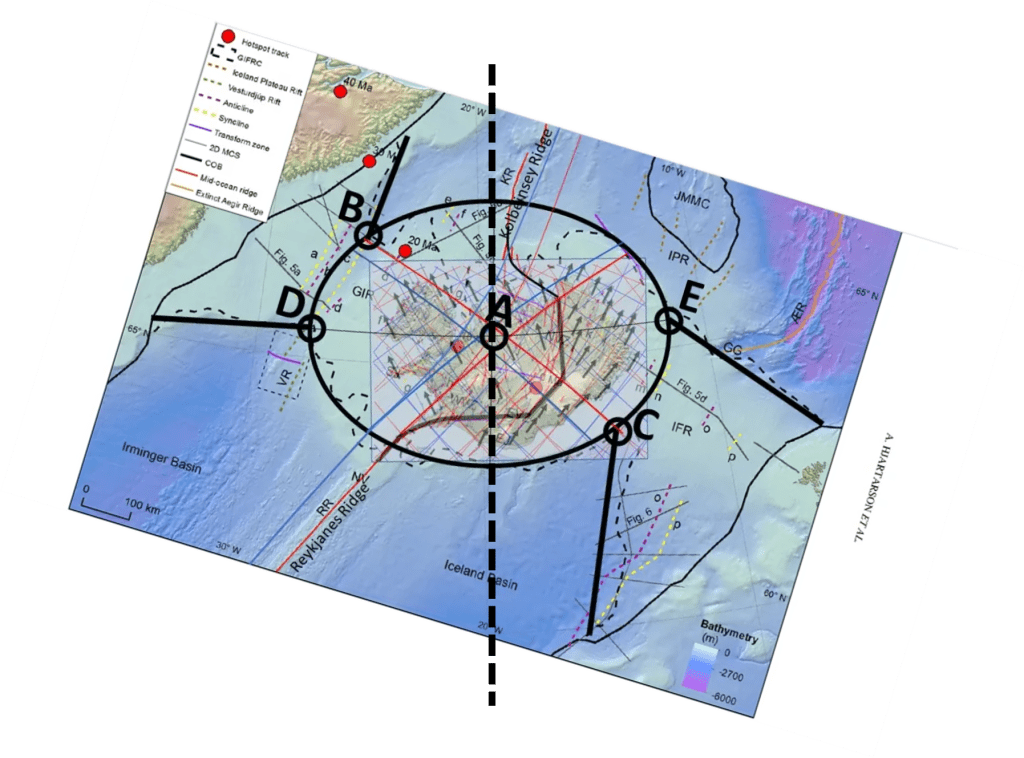
This shows how the two ridges are symmetrical around the Icelandic abyss, with D and E being the end points of the major axis. B and C are also on the periphery of the abyss, on the end points of the same convection roll. https://www.lyellcollection.org/doi/full/10.1144/sp447.14
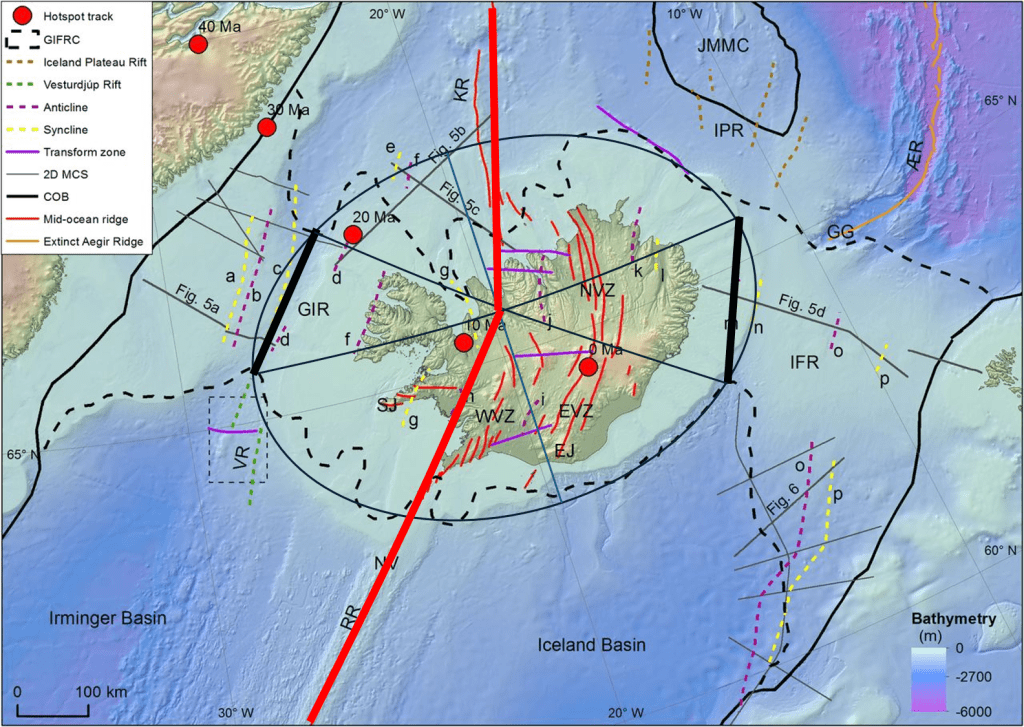
Extrapolating the mid-ocean ridges, showing that they meet at the central point of the elliptical form of the Icelandic plateau, and marking the divisions of the Greenland and Faroe Ridges respectively, also contributes to realizing the symmetrical aspect of the structure as a whole.