
At the start of the 20th century, geology faced a fundamental problem:
continents appeared to move, but no physically acceptable mechanism existed.
In 1912, Alfred Wegener presented the theory of continental drift. He argued that continents had once formed a single landmass (Pangaea) and later separated. His evidence — fossil correlations, matching geological structures, and continental fit — was compelling. However, Wegener could not provide a convincing driving force, and his ideas were widely rejected.
Meanwhile, a crucial breakthrough came from physics. Between 1896 and 1905, building on discoveries by Becquerel and the work of Ernest Rutherford, scientists established that radioactive decay produces heat. This insight solved a major constraint: Earth was not simply cooling, but continuously generating internal heat. By the early 1900s, it became clear that Earth possessed a long-lived energy source capable of driving internal processes.
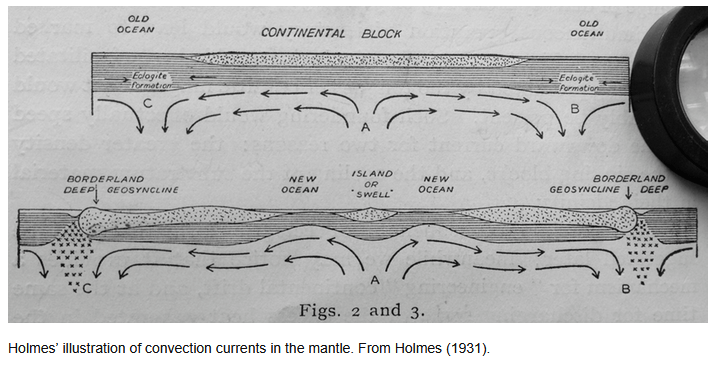
The next step was to understand how that the radioactive decay provided primary energy. In 1928–1929, Arthur Holmes proposed that heat inside the Earth drives mantle convection. He suggested that hot material rises and cooler material sinks, forming large-scale circulation patterns. Crucially, Holmes connected this internal flow to the drift of continents — proposing that convection currents could carry them. This was the first physically plausible mechanism linking Earth’s internal energy to surface motion.
However, direct evidence was still lacking — especially beneath the oceans, which remained largely unexplored.
That changed after World War II. Between 1950 and 1962, advances in sonar mapping revealed mid-ocean ridges, deep-sea trenches, and the global structure of the ocean floor. In 1962, Harry Hess proposed seafloor spreading: new oceanic crust forms at mid-ocean ridges, moves outward, and is eventually consumed at subduction zones.
Soon after, in 1963, Vine and Matthews demonstrated symmetrical magnetic striping on the ocean floor, providing strong confirmation that seafloor spreading was real and continuous.
The Synthesis (Late 1960s)
By 1967–1968, these ideas converged into the modern theory of plate tectonics:
- Radioactivity (1896–1905) → provides the internal heat
- Convection (Holmes, 1928–29) → organizes that heat into motion
- Seafloor spreading (Hess, 1962) → reveals how crust is created and recycled
- Magnetic evidence (1963) → confirms continuous movement
The Earth was finally understood as a dynamic system, not a static one.
The Physical System
The emerging model describes a coupled system:
- Heat from radioactive decay drives mantle convection
- Convection creates organized flow within the mantle
- This flow moves rigid lithospheric plates
- Plates:
- diverge at ridges
- converge at subduction zones
- slide past along transform faults
Continents are therefore not independent — they are embedded in moving plates, which reflect deeper flow patterns.
The Deeper Insight
The key realization of the 20th century is that Earth behaves as a thermally driven engine:
- Energy source → radioactive decay
- Transport mechanism → convection
- Surface expression → plate tectonics
What began as disconnected observations became a unified physical framework linking nuclear physics, fluid dynamics, and geology.
Extending the Framework
The classical model (Holmes → Hess → plate tectonics) established that convection drives tectonics.

 Magic Magma