
Examining Lake Baikal suggests that it can be interpreted as a surface expression of a deep-seated geodynamic process, potentially associated with a lower mantle convection roll extending 15° from east to west.
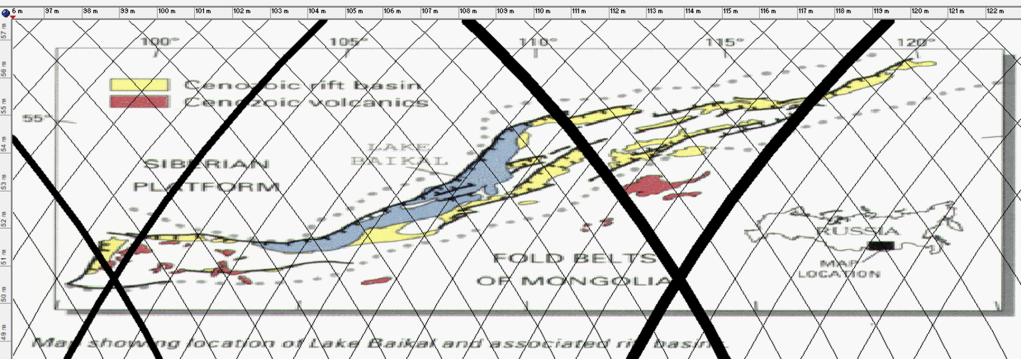
The Baikal Rift Zone can then be subdivided into five distinct structural sections, as shown below:
- Western Segment – A deep, east–west–oriented basin forming the western extremity of both the lake and the rift system.
- Central Basin – The deepest portion of the lake, representing the core of rifting activity and maximum crustal thinning.
- Northeastern Segment – A structurally complex area aligned with the boundary between adjacent tectonic or mantle-flow domains (interpreted here as polygonal convection cells).
- En Echelon Rift Systems – A series of east–west–trending, staggered rift structures situated between boundaries of different lower mantle flow layers, suggesting segmented deformation linked to deeper dynamics.
- Eastern Termination – The distal end of the rift complex, where deformation becomes more distributed and transitions into surrounding tectonic regimes.
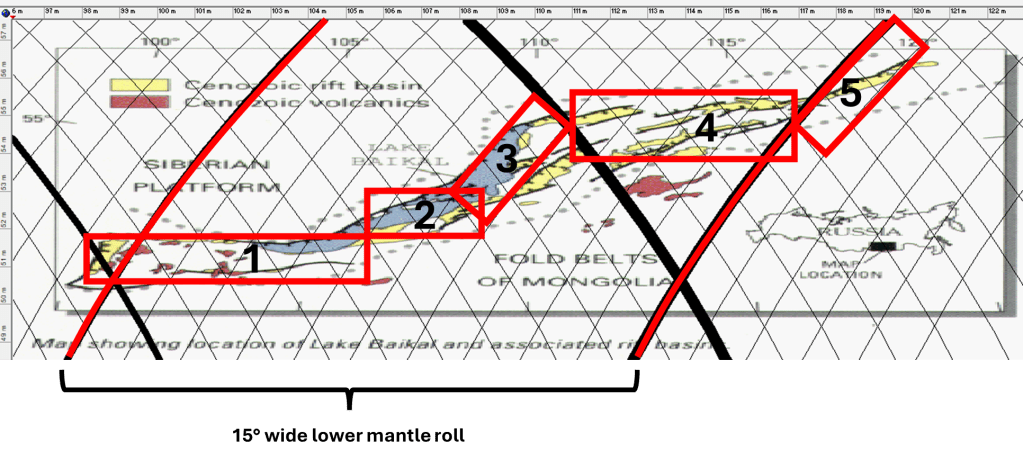
The principal rift axis appears to be located at the intersection of the central basin (2) and the northeastern segment (3), where structural and dynamic influences converge.
Lake Baikal is the deepest lake on Earth, reaching a depth of about 1,642 meters, and contains approximately 20% of the world’s unfrozen freshwater, making it one of the most significant hydrological reservoirs on the planet.
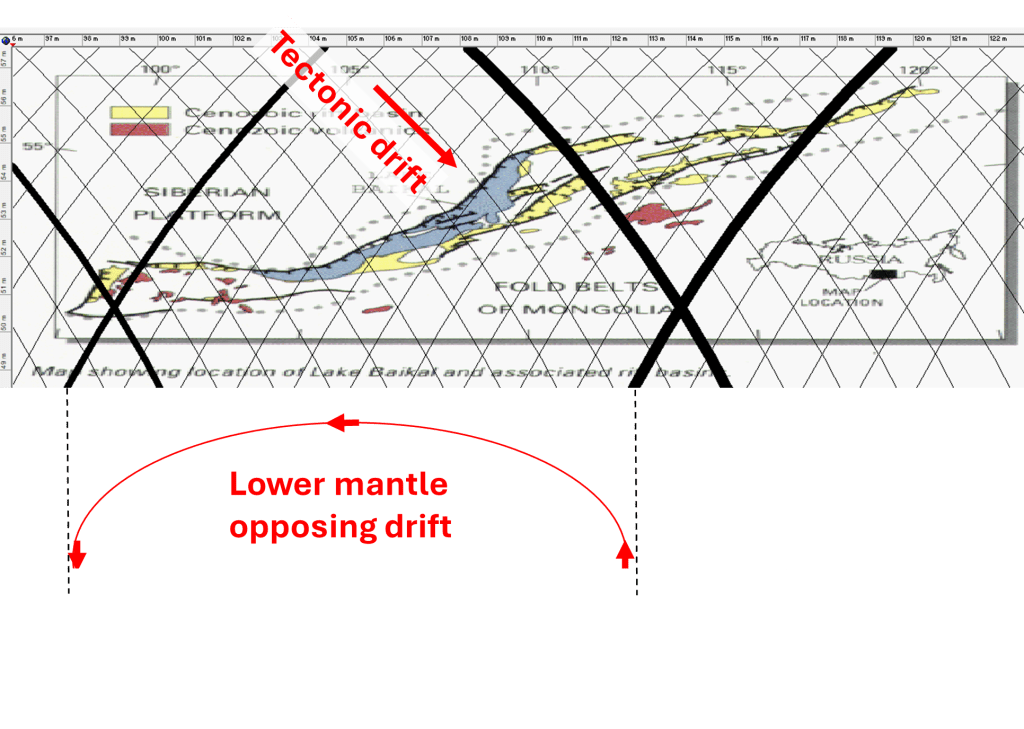
In this interpretation, the convection roll rotates counter to the direction of tectonic plate drift, helping to sustain and localize an extensive continental rift system. To show how the tectonic drift is opposed by the convection roll of lower mantle, this drawing below is added. It is not to scale, and the upper mantle convection rolls are omitted for clarity. But this is how it works.
- The Baikal Rift Zone is often explained in conventional geology as a result of:
- Far-field stresses from the collision of the Indian Plate with Eurasia
- Lithospheric extension within the Eurasian Plate
- Here, a deeper mechanism is added:
- A large-scale lower mantle convection roll imposes stress on the tectonic plate.
- Rotating opposite to plate motion, it thereby enhances extensional stress, stabilizing and sustaining the rift over long geological timescales.
- The en echelon faulting often reflects oblique extension, which can result from interacting flow directions between mantle layers.

 Magic Magma