
The Afar Triangle connects with the key equatorial division point, as the rift valley extends to there:
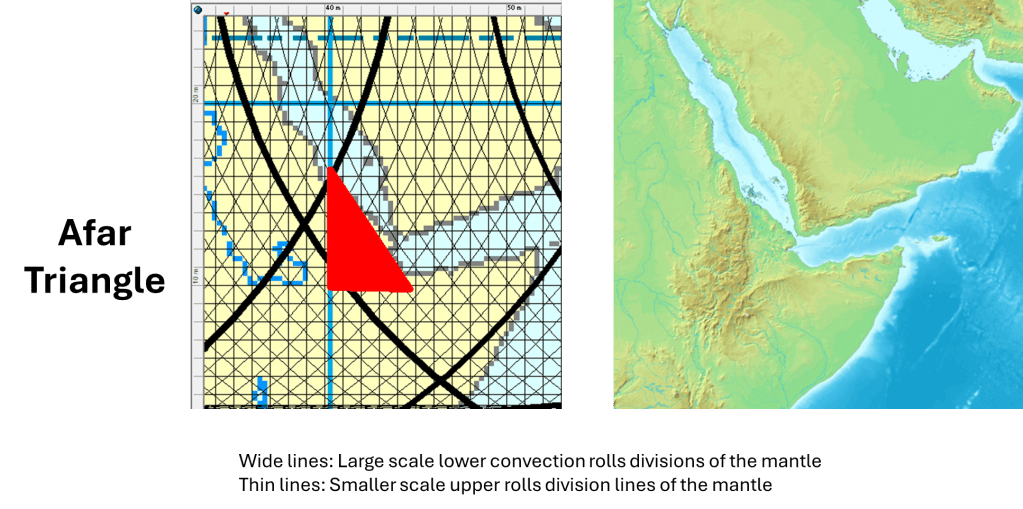


The Afar Triangle occupies a key geometric position within the mantle flow system. It is located at what can be interpreted as a corner of a larger convection framework, where different structural directions converge.
Its triangular shape is not incidental. The geometry is well defined:
- the southern boundary trends roughly east–west
- the western boundary trends north–south
- the eastern boundary trends northwest–southeast
This configuration is consistent with earlier observations that similar directional patterns frequently appear in regions influenced by mantle convection rolls. In particular, these orientations correspond to the dominant structural directions expected where mantle flow organizes into a grid- or diamond-like pattern that is reflected at the surface.
The Afar Triangle therefore represents more than a tectonic junction. It marks a point where:
- different directions of mantle flow interact
- deformation becomes concentrated
- and surface structures take on a geometrically organized form
This makes it a critical location within the broader East African Rift system.
A Key Junction in the African Rift System
The importance of the Afar region becomes especially clear when viewed in relation to the East African Rift.
The rift system in eastern Africa trends predominantly NE–SW, forming a broad zone of distributed extension across the continent. As this system propagates northward, it meets the Red Sea rift at Afar.
This intersection is not random.
Instead, it reflects the meeting of:
- a continental-scale extension zone (East African Rift)
- and an oceanic spreading system (Red Sea and Gulf of Aden)
At this junction:
- the geometry of the rift system changes
- deformation becomes more focused
- and the transition from continental rifting to oceanic spreading is clearly expressed
Connection to Mantle Roll Geometry
From the perspective of mantle dynamics, the Afar Triangle can be interpreted as a surface expression of deeper mantle currents.
If mantle convection is organized into rolls and their intersections form angular or diamond-shaped patterns, then:
- the edges of the Afar Triangle align with these structural directions
- the triple junction reflects a node within this system
This provides a coherent explanation for:
- the triangular geometry
- the alignment of rift branches
- and the concentration of tectonic activity in the region
Why Afar Matters
The Afar Triangle is therefore a key point in the Great Rift of Africa:
It is where a NE–SW-trending continental rift system meets a north–south-oriented oceanic spreading system, within a geometric framework that reflects deeper mantle flow structures.
This makes it one of the clearest locations on Earth where:
- surface tectonics
- geometric patterns
- and mantle dynamics
can be studied together as parts of a single system.

 Magic Magma