
The Ring of Fire is in fact circular, and 15 main parts of it are pointed out on the map below. The shape of the Ring of Fire is indeed circular, because the volcanoes of Antarctica fit into the area in between two elliptical shapes drawn with its outer limits marked by two points on equator, at the coast of Indonesia and South America, respectively. The two points are characterized by subduction zones. Let us examine this most active area in the World, in terms of seismic and volcanic activity. Looking at the arrows and lines, it is easy to understand how reality fits with the model.
- The first point pointed out on the map is the subduction zone of the Philippian Plate at the coast of Indonesia. It is a triple point where both the Philippian Plate and Pacific Plate meet with Indonesia. The South American counterpart on the equator is found exactly 150° west of this point. It fits to the width of five large-scale convection rolls.
- The Challenger Deep is the lowest point on Earth. It coincides with the inner margin of the Ring of Fire as drawn here. The convection rolls of different layers coincide with the area.
- Honshu Island of Japan clearly coincides with the convection rolls model, and is also within the elliptical area of the Ring of Fire.
- Kamchatka has been examined in other posts here, and the volcanic zone follows the alignment of convection rolls. It falls into the elliptical zone in similar way as Honshu Island.
- The Aleutian Islands form an arc from east to west. The easternmost part seems to follow the path of a division line between convection rolls. The central part crosses a large-scale convection roll, and the western part connects with Kamchatka. This arrangement indicates why most areas fall within the form of two ellipses, with short segments originated from convection rolls division lines.
- Cascadia is mentioned in two of the main articles found on this site. Subduction and divergent boundaries are found in the area.
- The Yellowstone National Pard is specially interesting, because usually it is not mentioned as a part of the Ring of Fire. As presented here, it is strongly related to it in two different ways. First, it is found on the circular line connecting the two points on equator. Second, it is found on the straight line of the mathematical minor of the elliptical forms, in continuation of the Central San Andreas Fault. New Zealand is on the other side of the Ring of Fire, where the other end of the said minor is found. With a little bit of logic at hand, it is then possible to analyze what kind of stress point this is, and thereby what causes the extraordinary activity level of Yellowstone Park. The usual saying, that it is a hot spot, is not enough. Of course it is a hot spot. But the settings of the Ring of Fire do indicate a complex origin of the volcanic and geothermal activity found there.
- The San Andreas Fault is found on the inner margin of the Ring of Fire and is used here to find that inner margin. The inner elliptical shape is not as clearly marked as the outer ring found by intersecting two obvious points on equator.
- Central America has some interesting features, especially volcanic activity where petrological evidence can be used to examine the explanatory value of the convection rolls model.
- This point has already been mentioned as the counterpart of point 1.
- The Galapagos Islands are found on equator in between the elliptical forms of the Ring of Fire.
- The Andean Mountains fit very well to both Convection Rolls Model, and the modelled Ring of Fire.
- The volcanoes of Antarctica are more seldom mentioned in geological literature than many others, but they are of course just as important for geological studies. The location of those volcanoes fits exactly into the circle. It indicates that the circularity is actually a precondition of the subduction zones system.
- New Zealand has been mentioned as a counterpart of San Andreas and Yellowstone, being on the mathematical minor of the circle.
- The Australian Mountains are not mentioned as a part of the Ring of Fire, but they are found within its realms, and it is said that they are still gradually growing higher.
In this way, it can be explained that the Ring of Fire is a wholistic area. It is correct to describe it as a ring, and should be studied more extensively .
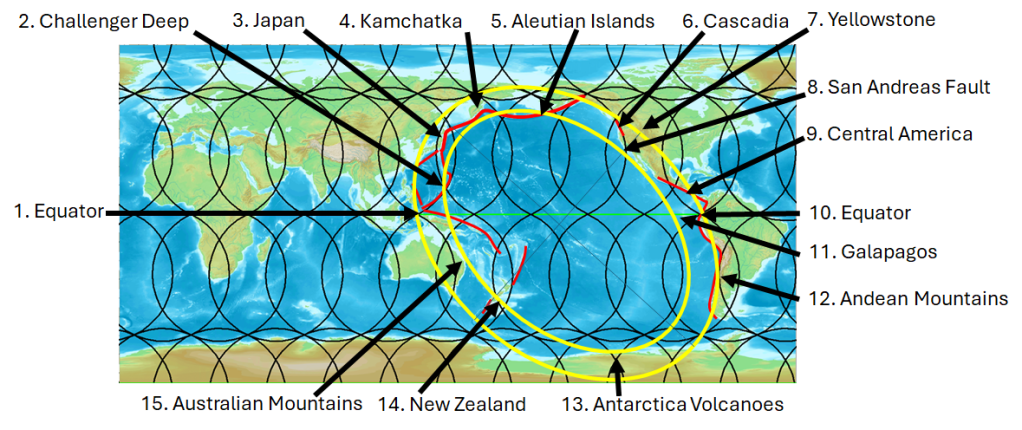
The circular form of the Ring of Fire.

 Magic Magma