
It can be difficult to explain how peridotite undergoes partial melting to produce basalt, and how that basalt subsequently migrates upward through the lithosphere. Within the asthenosphere, there are no open voids or fractures through which melt can simply flow. Therefore, an important question is how the melt becomes concentrated and how it is transported upward through the ductile portion of the tectonic plate.
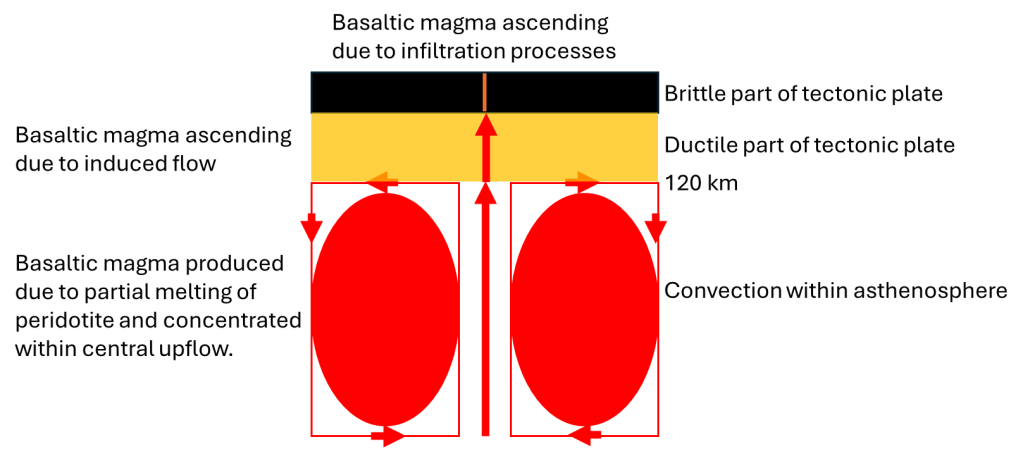
This schematic proposes that partial melting occurs in regions where pressure is reduced due to tectonic movements above. In addition, the interaction of adjacent convection rolls should combine their thermal influence with symmetric heat radiation, creating localized zones where conditions are favorable for partial melting.
The upward transport of melt through the ductile lithosphere must be assisted by some focusing mechanism, allowing it to move in narrow, directed pathways. Evidence for such pathways is found in the sheeted dike complexes within ophiolites, which could represent the uppermost expressions of these ascending melt channels.
One possible physical analogy is the Munroe effect, in which energy is focused into a narrow jet capable of penetrating solid material. In this context, a comparable mechanism might involve the concentration of thermal energy or stress along specific lines or zones, enabling sustained, directed upward flow through the ductile material. The symmetrical flow lines do then have to provide an appropriate “standoff”, a key concept regarding the physical preconditons of Munroe effect. Some might say that explosion on one hand and a steady process on the other hand are not comparable, but considering that the process is the same, even though one is short term, the other long term, the results will be similar.
Beneath oceanic plates, where the lithosphere is approximately 100 km thick, such focused flow could allow basaltic melt to traverse the ductile region. Upon reaching the brittle upper lithosphere, the melt would then exploit fractures and fissures, continuing its ascent.
Finally, as pressure decreases, volatiles exsolve from the magma, causing rapid expansion and increased buoyancy, which further drives the magma toward the surface or the seafloor.
 Magic Magma