Uncategorized

What if we look at Australia as a puzzle?

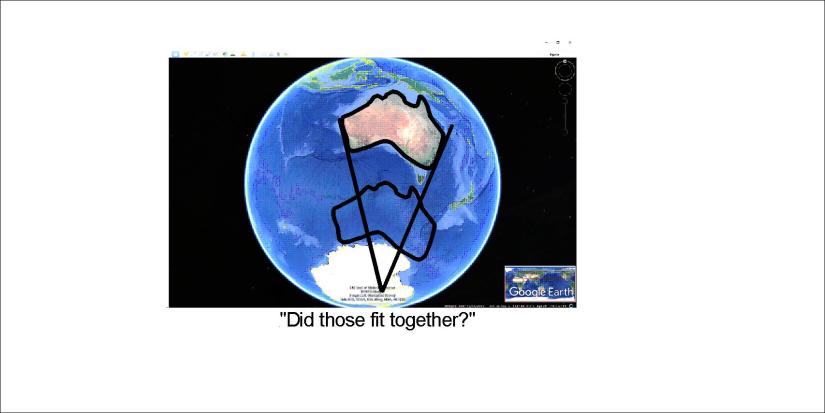
Each continent has a position in dynamic puzzle of Earth. Here is Australia:

Ástralía 01

At the latitudes where Australia and Antarctica split apart a 100 million years ago, close to 60°S, Australia would span 60° from east to west. Drifting northwards with the role of a puzzle it maintains the shape of the time when it split apart from Antarctica. Scientists can then easily “play back” the continental drift to the exact position where the division process took place. Looking forward to it.

Uncategorized

How did the Reykjanes Ridge become symmetrical?

Considering that Iceland has symmetrical drift vectors, pointing NE and NW respectively, how did the Reykjanes Ridge get mirrored magnetic anomalies compared to its axis aligned NE-SW? We can have a look into it:
Landrek - Ísland 01

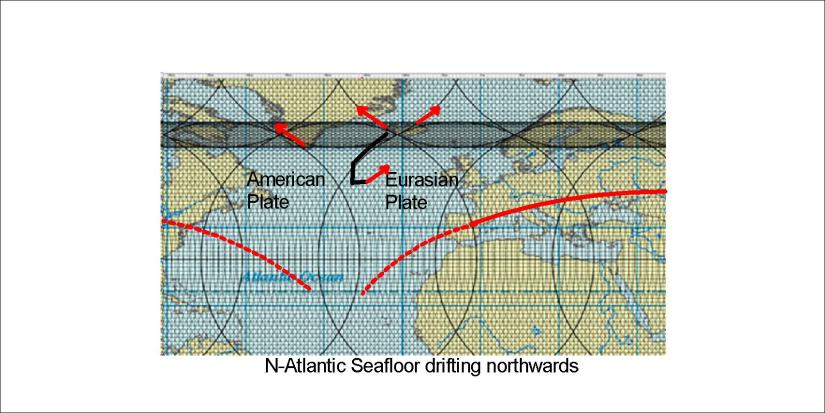
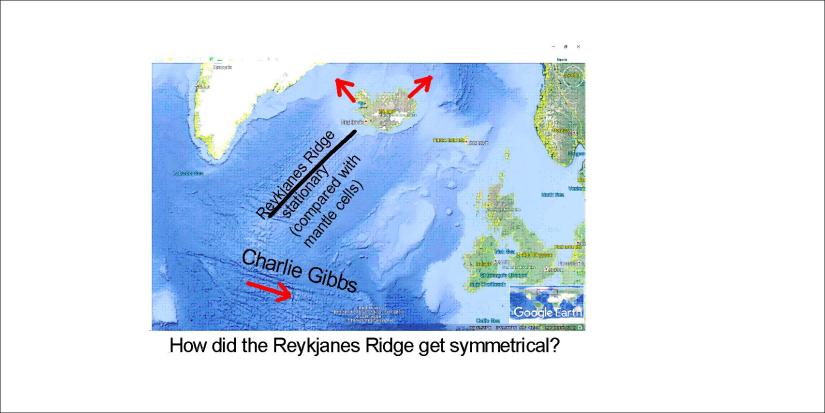
The rotation of N-American and Eurasian plates (along with Africa) is rather symmetrical and in coherence with the directions found in eastern and western parts of Iceland. If these vectors were prolonged along the Reykjanes Ridge, this would make no sense. The puzzle is dynamic, and whereas the Charlie Gibbs Fracture Zone can explain the discrepancy, another drawing on a map is added:
Landrek - Atlantshaf

If the Reykjanes Ridge remains stationary over the relevant division line between upwelling convection rolls, when the sea bottom south of Charlie Gibbs is shifted eastwardards compared to the convection cell system, then the Ridge can be regular. When it comes to Iceland, a similar shift is found in Southern Iceland, and in Northern Iceland the division line is directed NS.

If this mechanism is active, it should also be measurable. In the South Atlantic, the ridge is mainly NS oriented.

 

Uncategorized

Tectonic drift of N-America and Eurasia – the new findings with GPS

Before we thought about the plates of N-America and Europe as splitting apart. Now we know more, namely that they rotate in opposite directions. Finding it out is not enough, though. We have to learn it.

Samsett mynd - landrek - 01

Please compare this with actual data, for instance of Landmælingar Íslands and NASA.

Also note the two vectors from Iceland. The vectors found in NW and NE of the country are symmetric around NS-axis (same deviation from North). It shows the role of the main mantle division line drawn on the basic map. These vectors are parallel to the rotation found farther to the south on the two continents.

The speed of the tectonic drift in Iceland is close to 2.5 cm a year, oriented towards NE and NW. It is faster than previously thought, when only the division rate of a little less than 1 cm a year for each plate was measured.

Uncategorized

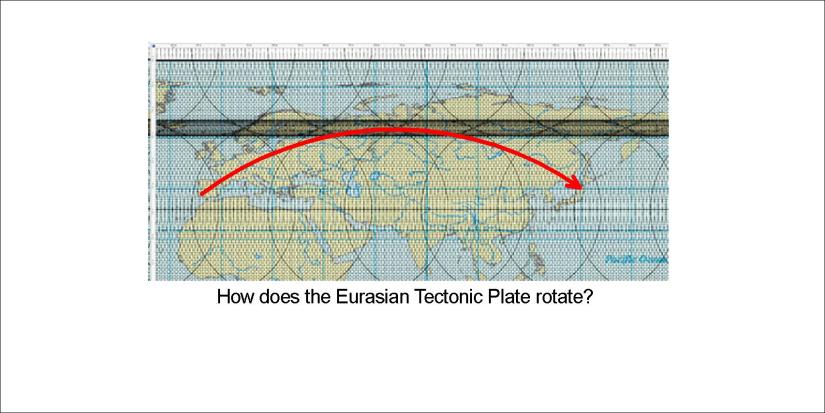
Rotation of the Eurasian Tectonic Plate

NASA website shows the accurate data. Generalizing the vectors showing the drift, we get a picture like this (please compare with the proper measurements):

Eurasia

This is quite in harmony with the opposite rotation of North America. The radius of rotation is considerably larger, as the Eurasian Continent spans 150° along the 51st parallel, but North America spans over only 60° at the same latitude.

This provides a base to analyze the tectonic drift further. Scientists can pinpoint the rotation points etc.

Uncategorized

Rotation of the North American Continent

North America rotates anti-clockwise away from the Mid-Atlantic Ridge towards the Pacific Plate. It is constantly displayed by NASA. The drift vectors are in harmony with the convection cells and mantle currents within the globe. Comparing with real data, an approximation for the drift can be made:

North America Rotation - approximate

In this way (please compare with data at the NASA website) we can see the present situation, and predict how the continent will move relative to the main lines. Especially, former position of main points of the convection cell system can be traced, explaining geological features in those areas in context with other circumstances during those times.