Uncategorized

Tjörnes Fracture Zone – the complicated feature of Iceland

Tjörnes Fracture Zone is found both on land and under sea at the north coast of Iceland.

It is similar to the SISZ, but differs as the weakness of the tectonic plate underneath is manifested in different pattern of epicenters.

Gosbeltin öll - Tjörnes

The description found in an article by Bryndís Brandsdóttir and others, here linked, is interesting, as it says that actually Tjörnes Fracture Zone is aligned EW. The three main lines of epicenters show how the polygons brake up in a regular pattern.

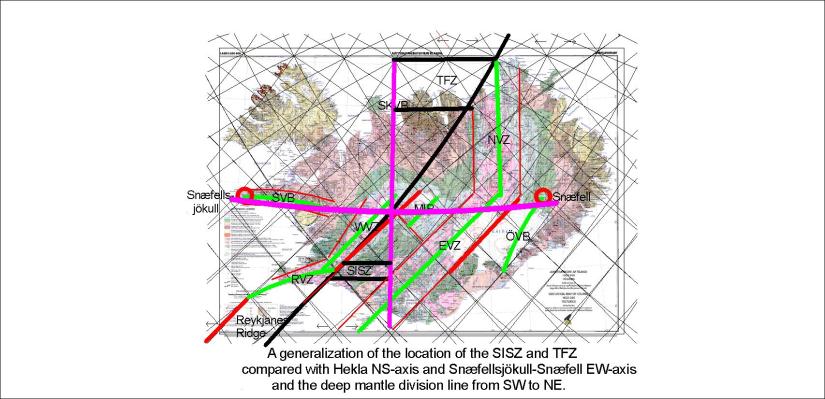
Sometimes manipulating with reality can make things clearer. To compare the earthquake zones with the main underlying factors of mantle convection and its polygon pattern and other implications, let us draw this map with Icelands main three axis:
Hypothetic Iceland - Not Real Iceland

The NS-axis through the craters of Eyjafjallajökull, Hekla, Hveravellir area and Drangey of the Skagafjörður Volcanic Zone, the EW-axis from Snæfellsjökull to Snæfell with Hveravellir at the center, clarify the locations of SISZ and TFZ.

Therefore, focusing on the mantle convection cell pattern gives a very clear picture. Tectonic drift is of course the reason for the dynamics of these earthquake zones, but this ‘reason for the reason’ is quite important.

The latitude of 64.75°N plays a major role, and the shift from NE trend to NS coincides with the division between large polygons in the southern half of Iceland and the smaller and more irregular polygons of the northern half.

Uncategorized

The double nature of volcanic areas of Iceland

The extinct volcanic zone of Skagafjörður tells a story about the double nature of volcanism in Iceland in general. The eastern North Volcanic Zone has taken entirely over the volcanic and rifting functions.Gosbeltin öll 01

The coherence between the South Iceland Seismic Zone and Tjörnes Fracture Zone becomes more appearent when comparint its location with the Skagafjörður volcanic Belt. The Tjörnes Fault Zone can be regarded as an EW-trending.

The large scale axis from Snæfellsjökull to Snæfell provides a connection to practically all the volcanic zones (and those classified as volcanic belts).

Uncategorized

The theoretic central line of Skagafjörður volcanic zone

The volcanic activity of the past two million years includes the Skagafjörður volcanic zone, active from 2 million years ago to about half a million years before present, but now extinct.

Árni Hjartarson wrote his PhD thesis about this area, and in his essay this map is shown:

file:///C:/Users/Lenovo/AppData/Local/Temp/Arni-Hjartarson-2003-PhD-heil-1.pdf

Skagafjarðargosbeltið - Árni Hjartarson - kort

The form is in harmony with the other peripheric zones:

Skagafjarðargosbeltið - og jaðarbeltin

This line extending from the still active Hofsjökull caldera of the Central Icelandic Volcanic Zone, is found both by tracing the central axis of the outlines of the volcanic zone as drawn by Árni Hjartarson and the relevant points of the convection rolls grid.

Uncategorized

The bent volcanic zones of Reykjanes, Snæfellsnes and Öræfajökull

There are three volcanic zones that show similarities when compared with the convection sysmtem of mantle underneath, namely Reykjanes, Snæfellsnes and Öræfajökull. They mainly cover two polygons each. The Öræfajökull and Snæfellsnes systems both start at the same latitude, one with Snæfellsjökull, the other with Snæfell. These mountains have the same system position compared with Hekla for instance. But this map is for everyone to ‘read’:

The bent volcanic zones

Uncategorized

The system – a quick look

Convection of the mantle is too simple to discuss. Heat from the core is carried upwards with magma flow. And it must circulate, up and down.

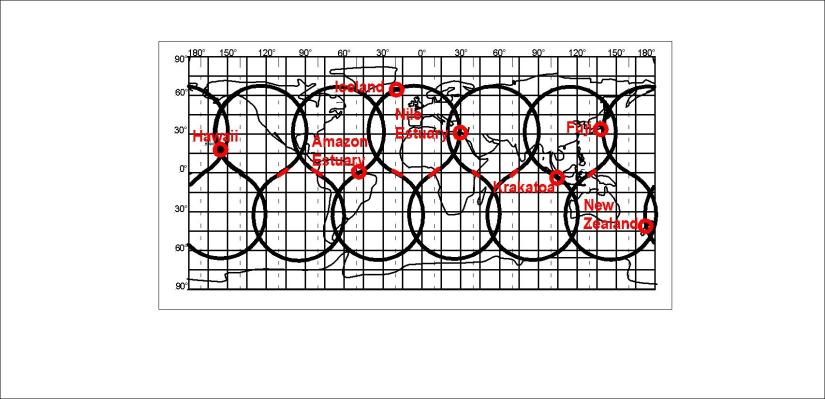
But the 3D model is harder to explain. The effect of rotation forces the convection to adhere to the plane of rotation. A fraction vector of the flow is also horizontal. Here on the drawing the path of the division line between the upwelling convection cells of lower mantle, and the relevant backflow are shown. It is of course also circulating around the globe.

The main belt of horizontal alignment

Looking at this map, you can see how Hawaii, Iceland, Indonesia, Japan and New Zealand are all a part of this main belt of magma flow. I include the estuaries two main rivers, Amazon and Nile. Take a look at equator, as land mass and ocean always seem to be divided where the magma division lines cross equator. And all the main ocean ridges are also found where the magma division lines cross equator. What else do we need to find? Well, remember that this bending line is calculated. It adheres to the Coriolis force always swaying in the same way mathematically for each latitude, with slow flow subject to no oscillation, with the same diameter as the radius of Earth as the basic length scale found along 32nd parallel where the flow is directly north-south.

Can you trace something more? I would like to see that, because I am interested in this 🙂