
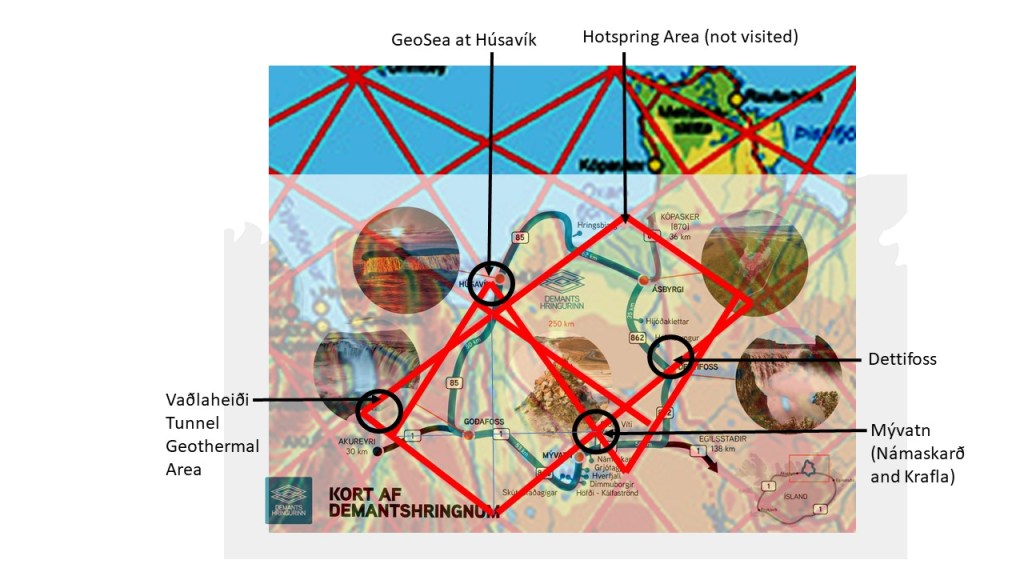
The volcanic zones of Iceland are quite distinct and well defined. The forces shaping them can also be defined, and here a few points regarding the mantle flow underneath are pointed out. The convection rolls division lines grid is drawn on a map base from Landmælingar (The National Land Survey of Iceland) with the tectonic drift vectors from 1993 to 2004 marked with blue arrows. Comparing these vectors with the polygons (and the effect of local up-welling and down-welling) indicates the resulting stress field.

1. The line between the convection rolls shaping the Reykjanes Ridge is here partly responsible for the formation of Krafla and Þeystareykir volcanic sites. The rolls are subducted by the polar rolls, but still make their presence felt, opposing western drift. Like most central volcanoes of the North Volcanic Zone, they are found west of the NS axis of the zone.
2. The up-welling polar convection roll of 120 km depth locally opposes the general drift to the west. This leads to the formation of Fremri Námar Volcanic Site.
3. In this area the two division lines of the upper most convection rolls and the 3rd layer almost coincide with each other, forming the Tungnafellsjökull Site.
5. Öræfajökull is maily a result of the fact that all four upper layers division lines coincide at a single point, in the same way as Hekla. But the volcanic zone extending from Öræfajökull to Snæfell is a result of spreading to the east, with geothermal heat also appearing at the edge of Vatnajökull from the two up-welling lines of convection layers 1 (upper-most) and 3.
6. The clear-cut edge of the East Volcanic Zone must be there for a reason. The reason is that the upper-most convection rolls down-welling division line is found there! The third layer coincedes with the upper-most one, exaggerating the effect, and has even a ruling effect as seen at the Kverkfjöll Volcanic System. Laki is found near the point, and therefor the Laki eruption seems to have been due to the effect of both Grímsvötn, providing the main flow of magma, and some effect of the NW-SE oriented upwelling line underneath Laki.
7. At these crossings of lines, the EVZ suddenly trends southwards. This is opposing the general NE-SW ´rule´, but it obviously coincides with the polygon east of the Westman Islands.
8. The Westman Islands Volcanic System is marked by a single polygon, actually the north-western half of it. Together with Eyjafjallajökull and Tindfjöll it is a part of the South Volcanic Belt, So it is regarded as separated from the East Volcanic Zone in a way. The main reason is that no rifting takes place there, as the eastwards drift actually takes place away from the Reykjanes Ridge south of the N-American/Eurasian division line (shown as thin black line).
9. In a way, Hveragerði is the most central place, because the large lower mantle convection rolls division line is found there underneath. The large scale division line is left a bit unattended, though, because the immediate effect of the small upper convection rolls is found more clearly, and the fact that the division between a pair of the upper most convection rolls follows the same path as the division line between the large scale rolls underneath. It is also confusing, that the large scale rolls division line under Iceland is up-welling, but the upper-most small scale rolls over them are down-welling.
10. This point marks the beginning of Icelandic geology, the turning point from Reykjanes Ridge to the Oblique Rift Zone of Reykjanes Peninsula.
11. The eastern edge of West Volcanic Zone is marked by down-welling division lines, in the same way as the East Volcanic Zone at the same latitudes.
12. These up-welling lines both oppose the general drift to the west, and provide direct stress on the area. At this latitude, the general tectonic trend changes.
13. The Ljósufjöll Volcanic System extends between two polygons, ending at the up-welling division line.
14. The other end of Ljósufjöll is found at down-welling division line.
15. The West Volcanic Zone starts to trend NS at this latitude, ending at a up-welling division line.
16. The Mid Iceland Volcanic Zone mainly takes up one polygon. Two volcanic systems, of Hofsjökull and Kerlingarfjöll, are found connected with different division lines. The local stress zone is actually following the main trend, but local deviation to the NE and general tension at this latitude, in between large and regular polygons south of the area and small, rather irregular polygons north of it, lead to a formation of a rather small volcanic zone. Actually, every main polygon along the 65th parallel has volcanic sites, from Snæfellsjökull in the West to Snæfell in the East.




 Magic Magma