Uncategorized

Shift of Fissure Alignment Along Central Iceland

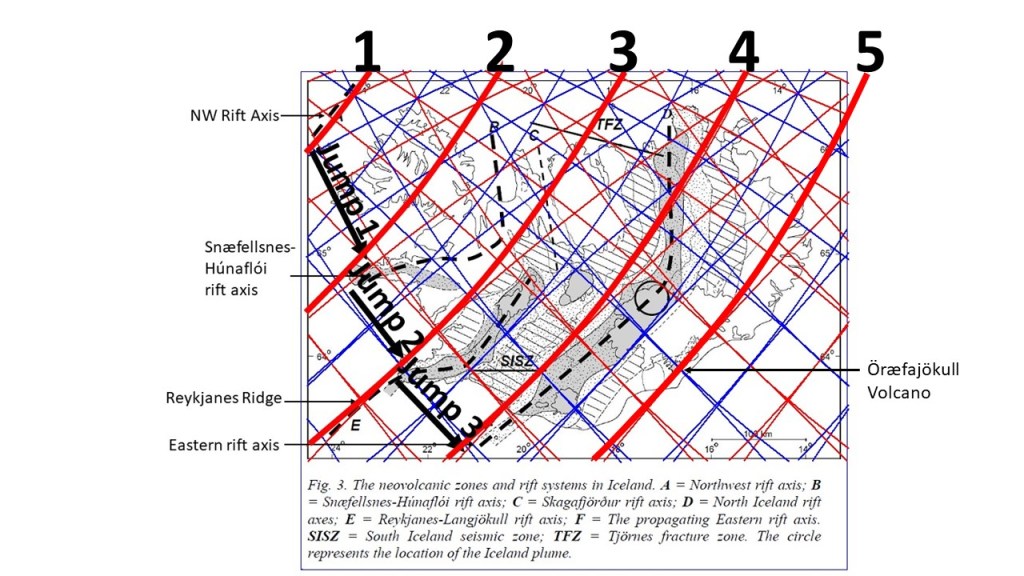
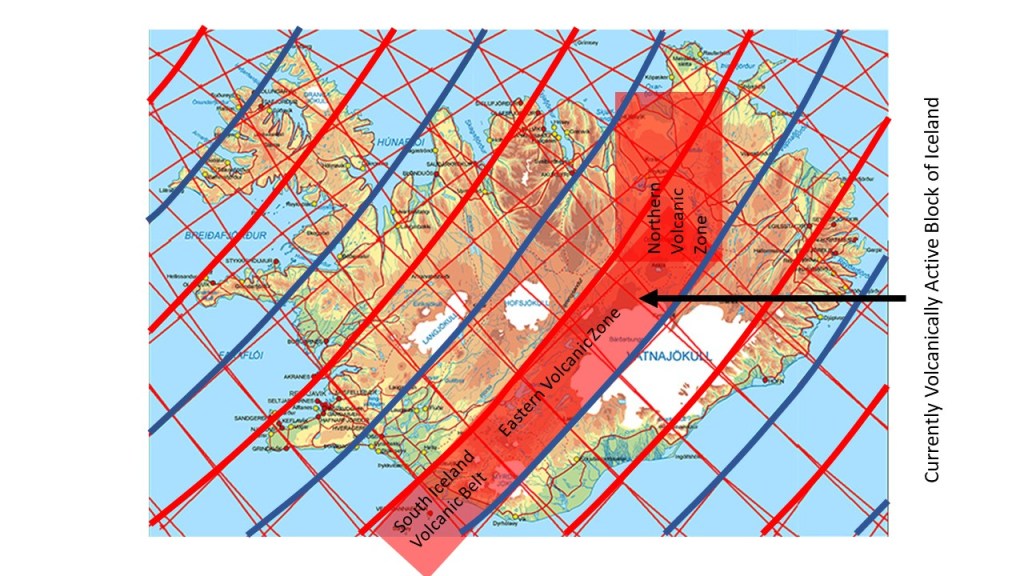
Volcanic Fissures in South Iceland are generally oriented NE-SW, but in North Iceland they are aligned more NS. The reason is that in South Iceland large polygons lead to pulling effect NW and SE, whereas the more complicated pattern in North Iceland leads to pulling to the East and West.

Shift Zone from NE-SW alingment to NS alingment

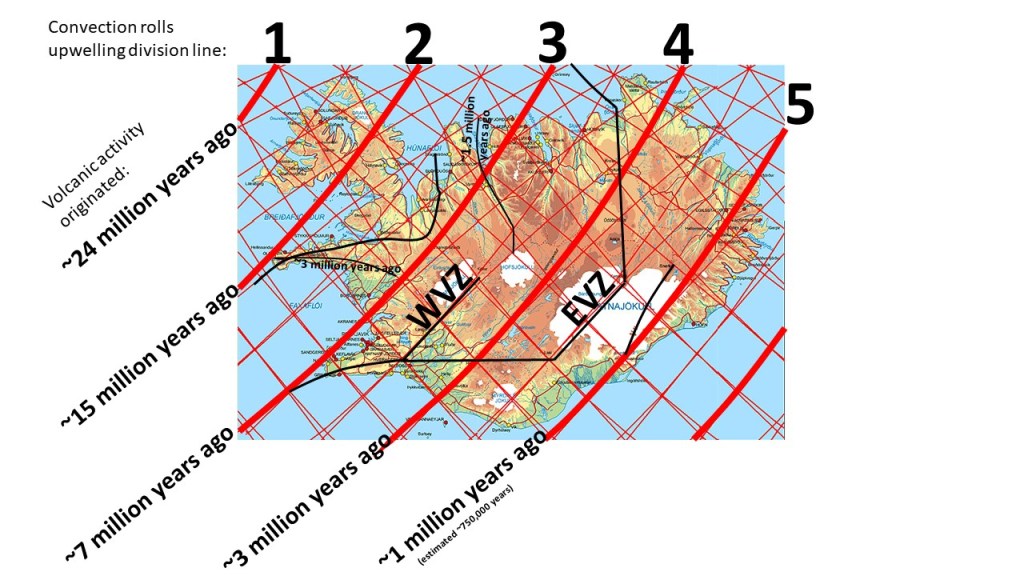
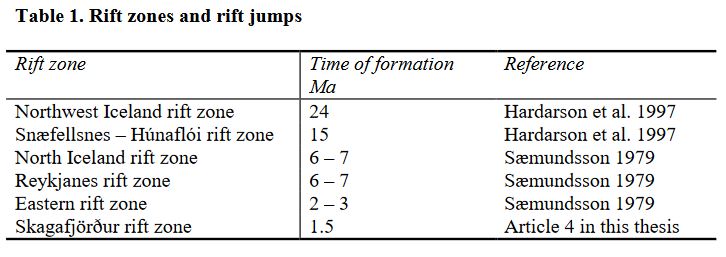
Most of SVB (Snæfellsnes Volcanic Belt) is aligned along the zone, covering two convection rolls. The WVZ (West Volcanic Zone) turns in the same way as the MIB (Mid Iceland Belt) within the zone, and the EVZ (East Volcanic Zone) and NVZ (North Volcanic Zone) meet within the zone, showing abrupt shift from NE-SW alignment to NS oriented fissures. The Öræfajökull Volcanic Belt covers two convection rolls, ending with Snæfell Volcano, at the southern border line of the shift zone.

It is also curios that the lower yellow line, is found along Hveravellir, equadistant from Snæfellsjökull and Snæfell, also found on that latitude. Those two volcanoes both mark the end points of the peripheral volcanic zones of SVB and ÖVB. Difectly north of Hveravellir is the extinct SKVB (Skagafjörður Volcanic Belt), and directly south of Hveravellir are Hekla and Eyjafjallajökull, all found on a NS-axis. Therefore, the Shift Zone Line also plays a decisive role in the overall symmetry of the distribution of the volcanic zones.

Uncategorized

The Rotational Factor of Seismic Areas in Iceland

The earthquake faults of North and South of Iceland generally move in opposite ways. It is easily explained. Here it is put into the context of convection rolls system.

Rotation of Seismic Areas

The South Iceland Seismic Zone is easily detected, with mainly right lateral faults. In West Iceland, a much weaker seismic zone follows the same principle. In the North, the circumstances seem to be more complex, but the effect is the same, except that the rotation effect is oppositte and the faults become mainly left lateral.

The Borgarfjörður Zone in the West is strikingly similar to SISZ, but less active, as it is within the North Americal Plate already, and is only affected by local factors. In the North, the epicenter are found to be distributed along NW-aligned lines, forming blocks of a few polygons. The faults found there tend to be perpendicular to these blocks.

Geology of Iceland: https://en.wikipedia.org/wiki/Geology_of_Iceland

Uncategorized

The Connection Points of Reykjanes Ridge and Kolbeinsey Ridge with the Icelandic Seismic and Volcanic Zones

The two ridges north and south of the country are connected with seismic and volcanic zones of Iceland in a similar way.

The Connections between Ridges and Seismic Zones

The Kolbeinsey Ridge connection framework seems to be more complex than that of the Reykjanes Ridge. Grímsey Oblique Rift forms a similar mixture of seismic and volcanic zone, bending and conncecting with the Kolbeinsey Ridge. But the Húsavík-Flatey Fault also connects with a southern extension of the Kolbeinsey Ridge. The Skagafjörður Seismic Area connects the extinct volcanic rift zone of Skagafjörður with the Kolbeinsey Ridge from the western side. The black arrows show the local tension due to the effect of the small convection rolls found below the tectonic plate at 120 km depth. The relevant red division line between those convection rolls is made slightly more prominent than the other lines of the convection rolls division lines grid.

Uncategorized

The Tjörnes Fracture Zone Framework

The Tjörnes Fracture Zone meets with the tectonic drift of the western side of the NS-axis of the North Volcanic Zone of Iceland, connecting it with the Kolbeinsey Ridge.

Tjörnes Fracture Zone

This shows how adjustments occur during tectonic drift due to the incosistency between the North Volcanic Zone and Kolbeinsey Ridge. West of KR, there is a weaker, but active part of the Tjörnes Fracture Zone. It covers the same convection roll span from east to west as the Borgarfjörður Transverse Zone. Reykjanes and SISZ cover the same convection rolls as the main part of Tjörnes Fracture Zone found east of the Kolbeinsey Ridge. https://www.sciencedirect.com/science/article/pii/S0191814106002653

Tjörnes Fracture Zone Framework

On this map, the function of shear pressure on the Tjörnes Fracture Zone Area can be seen. The earthquake epicenters follow the convection rolls division lines closely.

Uncategorized

Tjörnes Fracture Zone Double Nature

To be able to analyze the Tjörnes Fracture Zone, first it has to be realized that it extends from Skagafjörður to Skjálfandi, and in the East and West coincides with two different volcanic zones. The western volcanic zone of the North, Skagafjörður Volcanic Belt, is actually neglected by most geologists, because it is volcanically extinct. Still it exists seismically, as shown here.

Tjörnes Fracture Zone within the settings of the active North Volcanic Zone and the extinct Skagafjörður Volcanic Belt.

Recently, many earthquakes occurred at Reykjanes, and now within the Tjörnes Fracture Zone. Here, the convection rolls division line of Reykjanes is pointed out, to show how it divides the TFZ into two areas, east and west of the line. The earthquakes start on the line, and then start spreading along the Kolbeinsey Ridge.

Here I point out: https://agupubs.onlinelibrary.wiley.com/doi/pdf/10.1029/2000TC900022