I am a geologist, graduated from the University of Iceland, and taught geology for a few years. I have gained some knowledge about Earth's inner structure, so I provide this website as my contribution to answer one of the greatest questions remaining within the realm of geoscience. Experiments show that the mantle should form convection rolls when close to the melting point. I took this literally, and calculated the dimensions and shape of these mantle convection rolls. Then I compare that model with the surface. This makes it possible to provide many interesting examples about geology found on my blog.
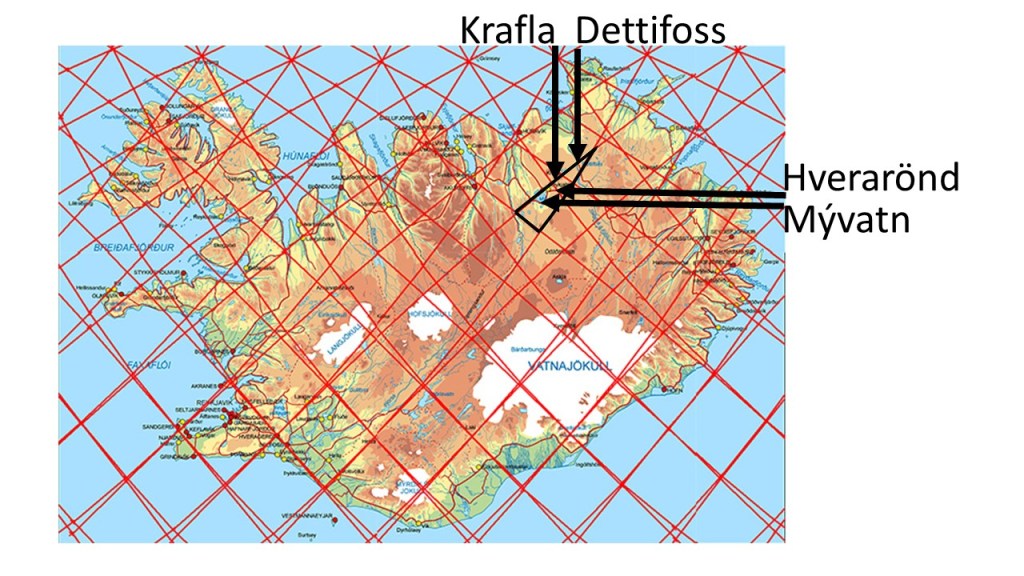
Mývatn is a major area of tourism, marked by the relevant division lines:
The Mývatn Polygon of Tourism
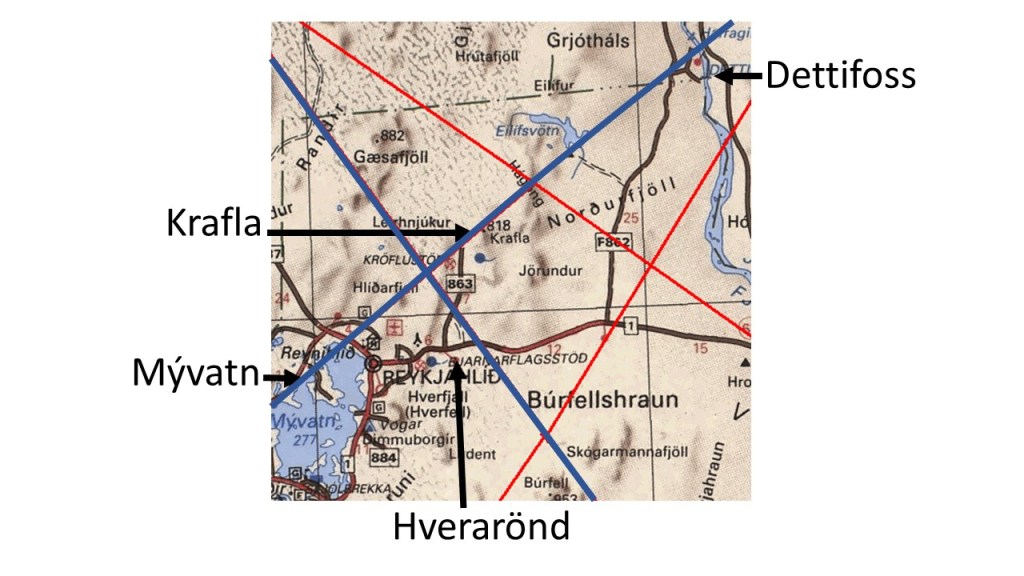
A division lines of lower mantle and the polar system division line of Hekla mark the area. The coast of Mývatn follows topography of the edge of the lower mantle division line. Farther to the NE, Krafla Volcano is on the edge of the mini-polygon. Then go farther still to the NE to find Dettifoss. The hot spring of Hverarönd are found at the SW edge of the mini-polygon.
A closer look is necessary to fully comprehend how the convection rolls division lines make the preconditions for these natural scenic spots to form.
Mývatn Tourist Spots
The pattern is complicated, but each line has a function here. This can be compared with other mini-polygons, like Kverkfjöll and Reykholtsdalur, and of course the areas of same latitude near Akureyri and Sauðárkrókur, where the same pattern is repeated with 1.5° interval. Here, the pattern coincides with the main division between the tectonic plates of N-America and Eurasia, resulting in these amazing features, tectonic, geothermal and volcanic activity.
Icelandic tourism has been developing fast, and most visitors go to a few places rather close to Reykjavík. The most famous scenic areas are all explainable in context with the convection rolls arrangement:
Polygon of Tourism
The Golden Circle includes Thingvellir, Gullfoss and Geysir. Thingvellir are located on the NS-axis of the polygon south of Langjökull, making up half of the West Volcanic Zone. At the east corner, Geysir hotspring area is found. About 10 kilometers east of there is Gullfoss.
The two main waterfalls are found in similar context, Hraunfossar accurately at the relevant corner of a mini-polygon. Laugarvatn and Hveragerði are then found on the main division line.
Öræfajökull Volcano can be said to be a corner-stone of the convection rolls system, as manifested in Iceland, due to its role as the keypoint for two different direct axis through Iceland. The North Volcanic Zone of Iceland trends directly northwards, and a sharp line can be drawn through the polygons appearing within the pattern formed by division lines of convection rolls of four different mantle layers.
The NS-axis of East Iceland
Various other volcanic and geothermal sites belong to the North Volcanic Zone, but here those happening to be located almost accurately on the NS-line are pointed out. The reason for this is highly mechanical, as the polygons tend to break up from one corner to the other when subject to horizontal pressure due to tectonic drift.
Öræfajökull and Kverkfjöll resemble each other, being placed at the edges of Vatnajökull Glacier. Askja and Hrúthálsar are similarly located centrally in the polygons. Krafla is located within a rather complicated hub of division lines, and the Öxarfjörður Geothermal Area is found at crossings at the seaside. it has long been a debate whether it is high temperature or low temperature area.
The 64th parallel in Iceland is a proof that Earth’s rotation has profound effect on topography, volcanism, geothermal and seismic activity of the globe. Here it is shown on a map in context with the division lines of convection rolls system:
The 64th Parallel in Iceland
In the western part, at the Reykjanes Peninsula we find a very interesting volcano, Thrihnukagigur, where you can enter a huge, emptied magma chamber. https://insidethevolcano.com/the-volcano/
South Iceland Seismic Zone: Then the whole area from Hveragerði Town to Hekla Volcano is defined as the South Iceland Seismic Zone. https://www.jonfr.com/volcano/?p=745
Landmannalaugar is a popular hot spring area, within the most powerful high temperature area of Iceland, the Torfajökull Area. In between the two points of Hekla and Laki, the East Volcanic Zone is found. https://en.wikipedia.org/wiki/Landmannalaugar
Laki Volcano is located within a long fissure, and is associeted with the Laki eruption which started in 1783, so fiercely that it is thought to have changed the history of the whole world. The magma of the eruption did flow from the Grímsvötn volcanic site, but Laki is actually older than that. The lava appeared on the surface when it crossed the division line found there, as seen on the map above. Laki is close to the eastern border of the East Volcanic Zone. https://en.wikipedia.org/wiki/Laki
Öræfajökull Volcano is the highest in Iceland. It is located on crossings of lines of different convection rolls layers. The existence of this mountain can then be explained, but without the convection rolls model, it is extremely difficult to find a reason for its location. https://en.wikipedia.org/wiki/%C3%96r%C3%A6faj%C3%B6kull
To travel along the 64th parallel, and the surrounding areas is interesting, and the fact that the convection rolls are regularly arranged exactly at that latitude, in the middle of the intersection zone of equatorial and polar parts of the convection rolls system, makes it so diverse and powerful.
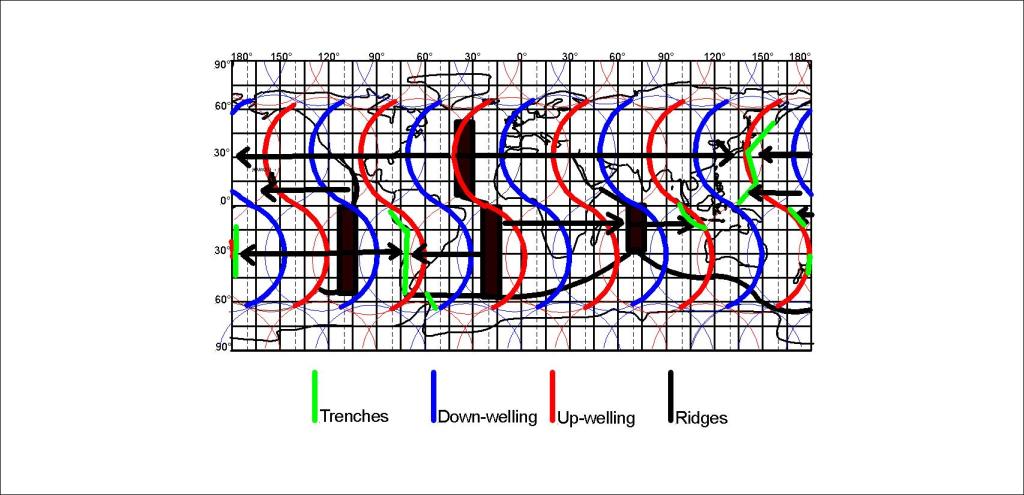
Here, tectonic drift is compared with the convection rolls. The arrows do not show correct directions, only latitudinal trend. It is the first step to understand the relationship between large scale convection rolls and drift of the tectonic plates.
Tectonic Drift Latitudinal Trend and Convection Rolls Location of Lower Mantle
The difference between North and South Hemisphere, and the relative inactivity of Indian Ocean Ridge, should be studied specially.
This has to be compared to real drift vectors, shown here:
Real Tectonic Drift Directions According to GPS Measurements
The consistency between both ridges and trenches on one hand and the convection rolls on the other hand can easily be seen. What becomes more difficult for us, is seeing how the system will develop as tectonic drift goes on, when it all looks fixed and we see the consistency between mantle currents and plate tectonics. It looks like if we move something, things would not fit any more! Still, it should become easier in the end, simply because these convection currents move the continents continually around.




 Magic Magma