Uncategorized

Lagarfljót River – Tension in Eastern Iceland

Lagarfljót River is found outside the volcanic areas of Iceland. The tectonic origins can still be traced to the Snæfell area, and the river follows the same alignment formula as the Reykjans Ridge, that is the mantle rolls extending from equator.
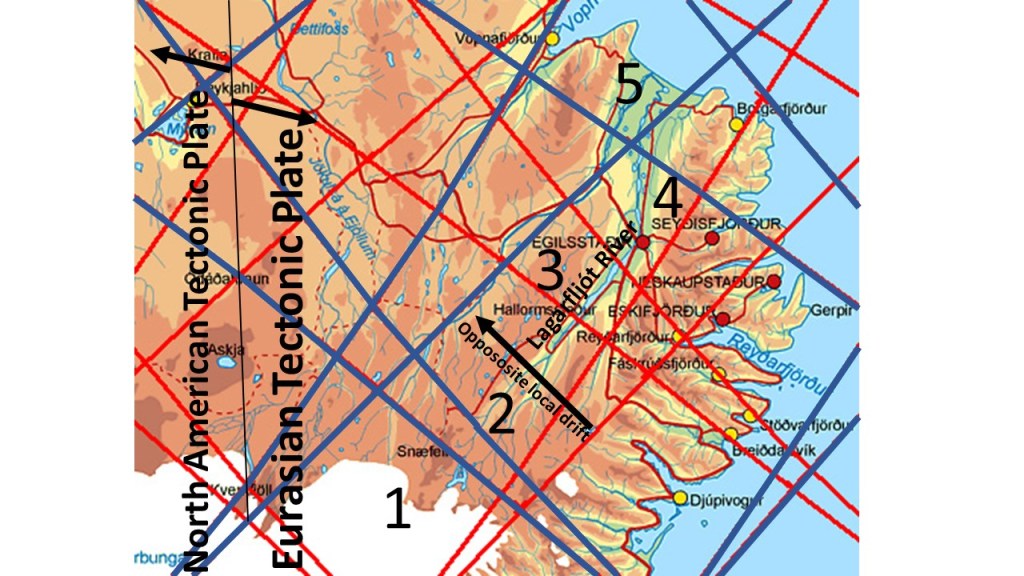
Lagarfljót Polygons

We can then analyse the Lagarfljót River according to the relevant polygons. Polygon 1 does comprise the origins at Vatnajökull, Snæfell and the upper most reaches. Then the valleys of polygon 2. Polygon 3 makes up the central part of the river. In polygon 4 it makes a sharp turn to the north, and flows along the NS-axis to the north corner of the polygon. The tension is then over, and the river makes a wide turn to the east towards the ocean.

Red lines show up-welling, so there is clearly opposite flow compared to main drift (the east- west component of main drift vectors) of Eurasian plate found locally.

Uncategorized

Explaining Tourist Attractions

The main tourist attractions near Reykjavík have been explained here. This map shows the location slightly more accurately:

The main tourist attractions near Reykjavík

Þingvellir on the NS-axis of the south polygon of West Volcanic Zone, Reykholt on the upwelling line extending from Reykjanes Ridge, Deildartunga on the EW-axis extending from the mini-polygon of Reykholtsdalur, Hraunfossar on the other up-welling line from RR, close to the east corner of the mini-polygon, Hveragerði on the main crossings of lines, Laugarvatn found on two down-welling upper lines, also above the main division line of lower mantle, Geysir on the down-welling line extending to the NW from Hekla, slightly offset from the main division line of lower mantel, Gullfoss found at the upper part of a gorge, which extends to the lowlands, actually marked by the down-welling division lines of Hekla-Geysir-Reykholtsdalur.

By zooming in on the places and studying the geological framework, the consistency between convection rolls division lines and the tourist attractions becomes clearer.

Uncategorized

The Main Tourist Attractions of the Tours Called Golden Circle and Saga Circle in Iceland

The inner forces of the Earth meet with the outer ones, resulting in natural wonders. Once when we know the basics, we can point out the sites one by one.

Main Tourist Sites of Golden Circle and Saga Circle

Thingvellir are located in the middle, at the NS-axis of the polygon. The area is being pulled apart, creating a rift valley along the polygon from SW to NE, with the most appearent site where the polygon breaks due to shear stress as the polygon is also subject to some pressure turning it.

Around at the edges Reykholt, Deildartunga and Hraunfossar are found in the northern part of the Saga Circle. In the southern part are Hveragerði, Laugarvatn, Geysir and Gullfoss. Gullfoss has a 3 km gorge, ending at the line that passes through Geysir nearby. All those places have thereby a connection with the convection rolls grid, in this case just about one polygon.

Uncategorized

Snjófjöll – The Lost Volcano of Iceland

There is a special volcanic site unexplained, outside the volcanic zones.

Snjófjöll Volcanic Site

Or is it inside the Snæfellsnes Volcanic Zone? Snjófjöll fits into a certain pattern associated with the convection rolls division lines. It is the counterpart of Askja, in the same way as Reykholtsdalur resembles Kverkfjöll and Hveragerði along with Hengill resemble Öræfajökull.

The location of Snjófjöll within the Western NS-axis of Iceland

In this way, the occurrence of volcanic activity at that spot becomes understandable. So is Snjófjöll Volcanic Site a part of Snæfellsnes Volcanic Belt, or is it the smallest volcanic zone of Iceland?

Uncategorized

The Longest River of Iceland – Thjorsa

Thjorsa is 230 km long and flows to the SW. It follows the polygons and the same direction as that of the East Volcanic Zone. But it can be analyzed further:

Thjorsa River Analyzed

The start of the main part of the river is at the edge of polygon 1, it flows just about equadistance from the two relevant division lines (also marking the western borger of the East Volcanic Zone) until it reaches the border line between polygon 2 and 3, where it bends along the division line. That is the point where the division between highland and lowland creates conditions for Iceland’s first large scale hydro-powerplant, Búrfell Powerplant. Then the river flows down to the 64th parallel, and flows along it, as the 64th parallel is also the axis of the South Iceland Seismiz Zone. At the very center of polygon 3, the river turns back to SW orientation, flowing down to the estuary, and the coast there coincides with the edge of the polygon.

Þjórsá https://en.wikipedia.org/wiki/%C3%9Ej%C3%B3rs%C3%A1

Búrfell https://en.wikipedia.org/wiki/B%C3%BArfell_(%C3%9Ej%C3%B3rs%C3%A1rdal)