
The geographical distribution of Iceland’s stratovolcanoes reveals two remarkably regular geometrical patterns. These patterns are of particular interest when examined within the framework of the Convection Rolls Model and in relation to the central axis of the Icelandic continental shelf ellipse.
1. The Central Axis and East–West Symmetry (blue)
in the distribution of Iceland’s main stratovolcanoes.
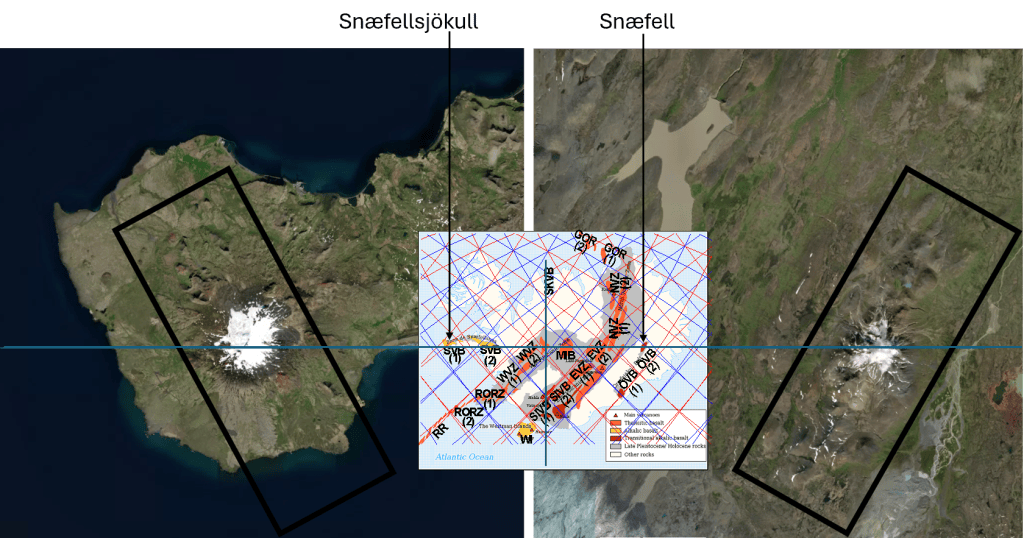
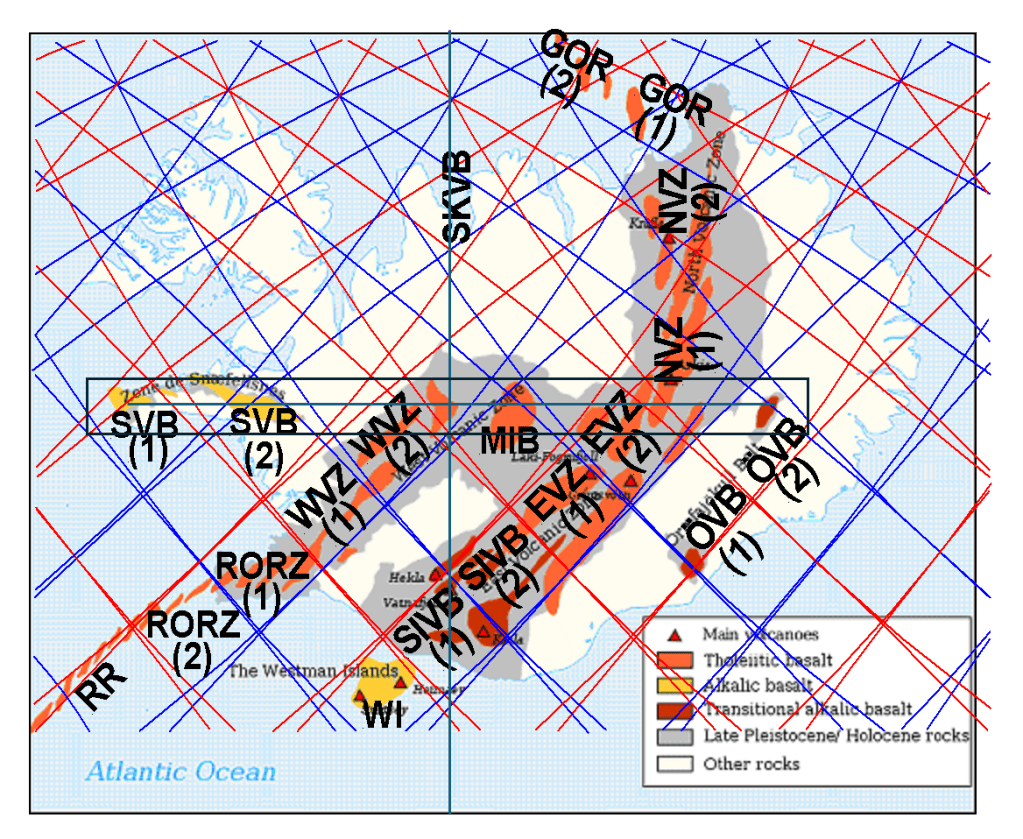
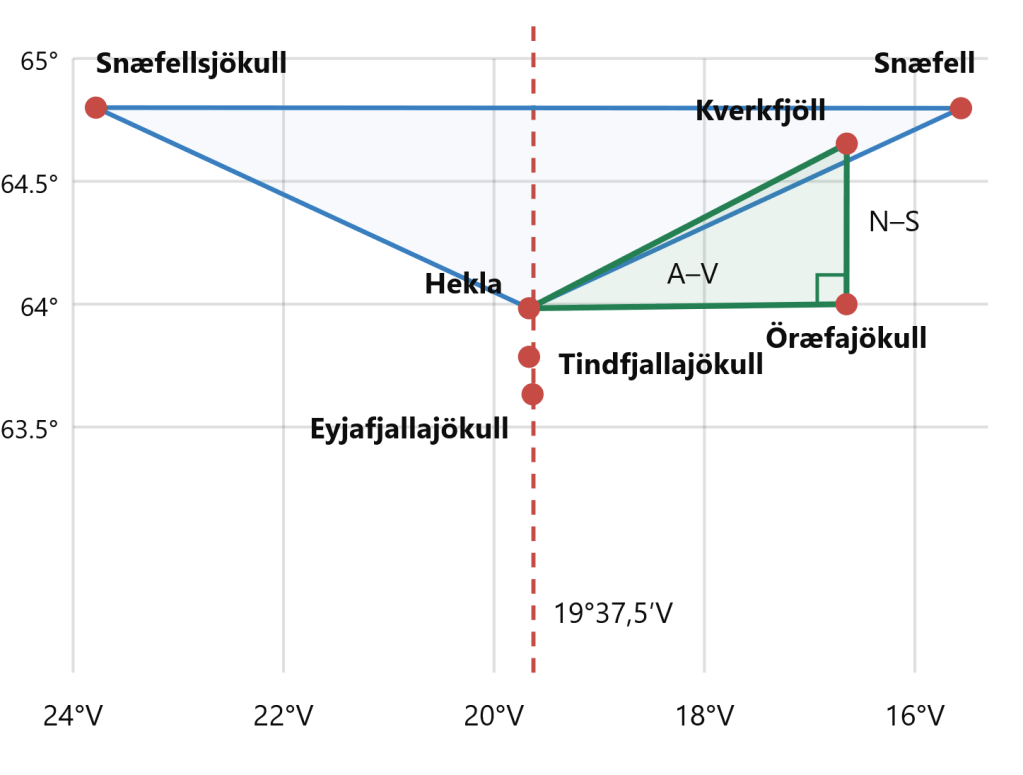
As shown here, three prominent stratovolcanoes in southern Iceland, namely Hekla, Tindfjallajökull and Eyjafjallajökull, are arranged along a north–south line, corresponding to the central axis of the Icelandic continental shelf ellipse at 19°37.5′W. A striking geometrical relationship is revealed by the positions of Snæfellsjökull on the Snæfellsnes Peninsula in western Iceland and Snæfell in eastern Iceland. These two stratovolcanoes are situated at virtually the same latitude, i.e. 64°48′N, at equal distances from the central axis of Iceland (the minor axis of the elliptical form of the Icelandic Platform). Together with Hekla, they form an symmetrical isosceles triangle. The alignment of Hekla, Tindfjallajökull and Eyjafjallajökull further defines the north–south axis of this geometrical arrangement.
It is particularly noteworthy that Snæfellsjökull and Snæfell belong to two geographically separated volcanic belts, the Snæfellsnes Volcanic Belt (SVB) and the Öræfajökull Volcanic Belt (ÖVB), respectively.
2. The Hekla–Öræfajökull–Kverkfjöll Triangle (green)
A second geometrical pattern emerges when Öræfajökull and Kverkfjöll are included in the analysis.
Öræfajökull is situated at the same latitude as Hekla, approximately 64°N, 3° farther east (that is also an indication of regularity). Directly north of Öræfajökull are Kverkfjöll, a large central volcanic complex with characteristics of a composite volcano. These three volcanic centres form a right-angled triangle:
- Hekla–Öræfajökull defines an east–west alignment.
- Öræfajökull–Kverkfjöll defines a north–south alignment.
- Hekla–Kverkfjöll forms the hypotenuse of the triangle.
The longitudinal separation of approximately 3° between Hekla and Öræfajökull is particularly significant within the framework of the Convection Rolls Model, as it corresponds to two 1.5° units of the proposed upper-mantle convection system beneath Iceland.
3. The Relationship to the Convection Rolls Model
The importance of these geometrical observations lies in their correspondence with the previously defined framework of mantle convection rolls. The central axis of the Icelandic continental shelf ellipse is closely related to the global geometrical framework of the model. The same meridian, 19°37.5′W, represents the northward continuation of the minor axis of the Antarctic ellipse. This axis was therefore not established on the basis of the geographical distribution of the Icelandic stratovolcanoes.
The seven volcanic centres examined here display several interconnected geometrical features:
- The north–south alignment of Hekla, Tindfjallajökull and Eyjafjallajökull.
- The east–west symmetry of Snæfellsjökull and Snæfell.
- The isosceles triangle formed by Snæfellsjökull, Snæfell and Hekla.
- The approximately right-angled triangle formed by Hekla, Öræfajökull and Kverkfjöll.
- The 3° longitudinal separation between Hekla and Öræfajökull, corresponding to two 1.5° convection-roll units.
Hekla occupies a central position in both triangular arrangements, linking the symmetrical distribution of stratovolcanoes in western and eastern Iceland with the geometrical arrangement of volcanic centres farther east.
4. Thoughts…
The distribution of Iceland’s stratovolcanoes appears to follow a coherent geometrical pattern extending across several distinct volcanic belts and systems. Although the individual volcanoes differ in geological structure, composition, age and eruptive history, their geographical positions exhibit a remarkable degree of geometrical correspondence. Within the framework of the Convection Rolls Model, these relationships raise the possibility that the locations of major volcanic centres are influenced by an underlying system of organized mantle flow.
The geometrical correspondence does not in itself establish a causal relationship. However, the occurrence of several interconnected geographical relationships, consistent with a previously defined model, provides a basis for further investigation. The focus here is therefore not solely on the geological characteristics of individual stratovolcanoes, but on their geographical distribution as a possible expression of the larger system of geophysical forces operating beneath Iceland. The geometrical arrangement of seven Icelandic volcanic centres in relation to the central axis of the Icelandic continental shelf ellipse. The blue triangle illustrates the east–west symmetry of Snæfellsjökull and Snæfell in relation to Hekla, while the green triangle illustrates the approximately right-angled arrangement of Hekla, Öræfajökull and Kverkfjöll.


