Blog

Uncategorized

Distribution of Mid-Ocean Ridges in the Southern Hemisphere

It is well known that land mass around equator is regularly distributed. The three mid-ocean ridges of the Pacific, Atlantic and Indian oceans are found to be aligned 90° apart, directly N-S, reaching southwards from equator a couple of thousand kilometers. Studying the N-S aligned volcanic zone of Northern Iceland, it is interesting to see that it is found directly north of the Mid-Atlantic Ridge of the Southern Hemisphere. The pattern of those three N-S aligned ridges therefore form an interesting pattern with Iceland included, far up north!

The drawing is superimposed on [Manuscript painting of Heezen-Tharp “World ocean floor” map by Berann]. https://www.loc.gov/item/2010586277/

How can these ridges be so regularly distributed, besides being found in context with the volcanic zones of Iceland? The answer is found in the convection rolls pattern formed by different layers withing the mantle. Together they form N-S oriented polygons, and the crust breaks in harmony with the resulting pattern. In many cases, though, ridges follow the division lines between convection rolls, and in some cases they follow other mathematical rules as well.

The fact, that the intervals between the parallel N-S sections span 90°, further adds to the feel of regularity. Each interval corresponds to the width of three convection rolls, each spanning 30° from east to west. To fully understand this, the whole system must be kept in mind, but this is a good beginning to consider what is going on.

Uncategorized

Mid-Ocean Ridges of North Hemisphere Compared

Three mid-ocean ridges of the North Hemisphere, Juan de Fuca, Reykjanes Ridge and the Mid-Indian Ridge, are found to be mathematically correlated to each other. 1) Their alignment follows the same formula 2) The angle between Juan de Fuca and Reykjanes Ridge is 90°, and between Reykjanes Ridge and Mid-Indian Ridge is 93°. According to the Convection Rolls Model, a ridge following division line between convection roll will most likely be positioned 1.5° east or west of the main lower mantle convection rolls division line. The Reykjanes Ridge are found to be offset in opposite ways, Reykjanes Ridge being west of the line and the Mid-Indian Ridge east of the line, adding up to extra 3°.

The three North Hemisphere mid-ocean ridges. The wide lines are drawn with 30° interval.

Red lines indicate the location of the relevant ridges. The fact that the relationship is of double nature, angle and alignment, gives this model an explanatory value. The shape and location of convection rolls can be calculated very accurately, and thereby additional information can be gathered about conditions, tectonics and geological activity of any area on Earth.

This was introduced at the 48th Workshop on Geothermal Reservoir Engineering, Stanford University, Stanford, California, February 6-8, 2023.

Uncategorized

Earthquakes near Langanes of Northeast Iceland

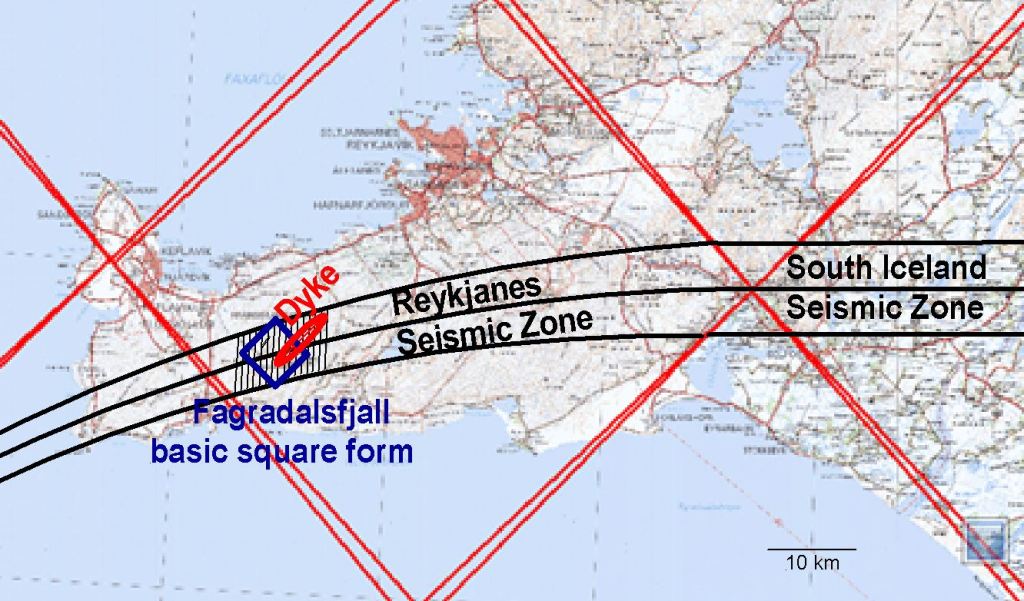
December 15th 2022 an earthquake swarm appeared out of Langanes at Bakkaflóadjúp near the Northeast coast of Iceland. Some 40 years ago earthquakes were also measured there. The earthquakes occur exactly on the line for the main division between large scale convection rolls as they extend all the way from equator. Not many words are needed to explain this, just two simple drawings, one from the National Met Office, and one map with the main division drawn on it, map base from National Land Survey of Iceland.

Location of earthquakes.
The division line of lower mantle.

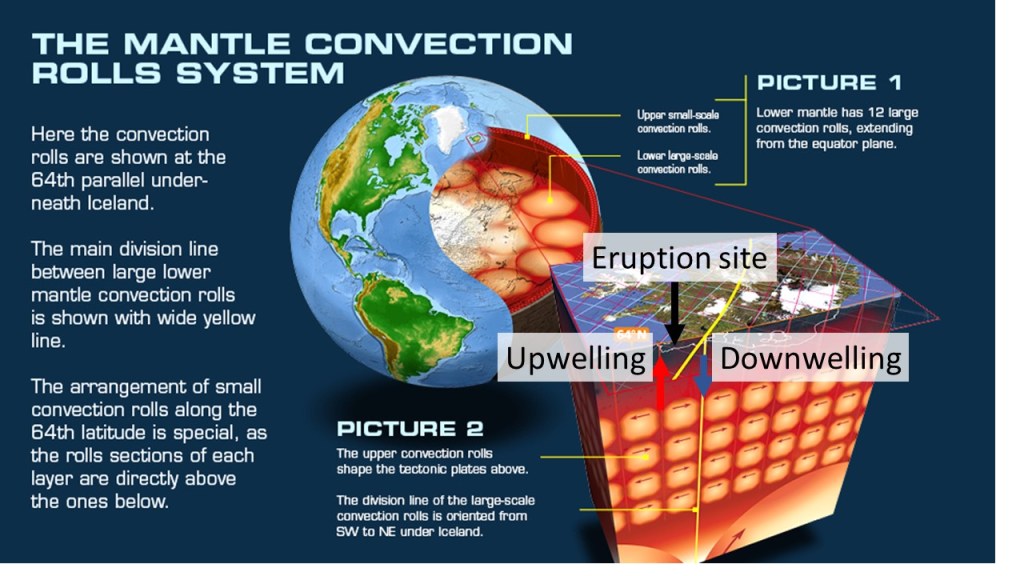
There are actually two layers represented with this line, one is the eastern side of the convection roll which creates the Reykjanes Ridge. That convection roll is then subducted by the northern more rolls, so it is found at considreable depthe at these latitudes of the earthquake area. But the same is true for the large scale structures of the lower mantle, and effect from there are expected to take part in triggering these earthquakes. The large scale rolls intersect each other, the equatorial roll being subducted, and the lower mantle division line is therefore found near the boundary between mantle and core.

Uncategorized

What do the Three Famous Rivers, Amazon, Nile and Mississippi have in Common?

The three rivers estuaries are all 60° apart, coinciding with the convection rolls system. A river flows on the surface, so how does it connect with the mantle? The answar is that water is the best geologist. It always finds the weakest spots, wherever they are, in order to make a path to flow along. The annual isostatic fluctuation at these estuaries is of global geophysical scale, especially for Amazon with 8 cm vertical movement of the crust every year.

The convection rolls exist because heat must constantly leave the inner part of the Earth. It has been shown with experiments that mantle material heated so that it starts convecting, and not made accelerating any further than that, does form convection rolls. It is logical that exactly those conditions prevail inside the Earth. These rolls have to extend from equator and sway in a regular way. The weather system and the ocean current system form curved paths as they move along, and so does the mantle. The theory fits everywhere, no one can deny it. And here we have one more manefistation. The three estuaries are all 60° apart as compared with the relevant central point on the 32nd parallel, of a circular path revealing the division lines between the main convection rolls of the lower mantle. It is even so that Mississippi and Nile are very clearly 120° apart, because the estuaries happen to be very close to the critical 32nd parallel, one flowing from the north, the other from the south.

In the drawing, the main upwelling lines of large scale lower mantle rolls are shown, and the relevant backflow lines of horizontal flow. These black lines are only relevant for the upper mantle, and in a way also for the core. The effect of those lines is so big that they are responsible for the location of all those three rivers. Newly, BBC made a TV series about exactly these three rivers. They are very special.

Uncategorized

Similarities between the Atlantic and Indian Oceans

At first sight, the Atlantic and Indian Oceans look different, but at equator they are geologically identical. Both cover 60° along the equatorial line, and both have a mid-ocean ridge as a central point.

Similarities between Atlantic and Indian Oceans.

Let us start with the Amazon Estuary, a point exactly on the equatorial line. The flow of water is of geological scale, and the annual isostatically vertical movement is measured to be 8 centimeters a year. It is understandable that this water flow does search out a weakness of the crust for reaching out to the ocean. 30° farther east, the Mid-Atlantic Ridge crosses the equator line, being almost aligned directly east-west over considerable distance. Then the ridge makes a sharp turn towards the south, and keeps that alignment within the south hemisphere. 30° farther east, we find the African West Coast, at the coastal line which most clearly appeared as a jigsaw puzzle line fitting to the coast of S-America. Then, 30° farther east, the Great Rift Valley of Africa is clearly found above some main division underneath, pulling the ground, bringing geothermal and volcanic activity to the surface. Then, 30° farther east, the Central Indian Ridge crosses the equatorial line, and at the same spot makes a turn directly southwards, in a similar way as the Mid-Atlantic Ridge. Then, 30° farther east, does the Sumatran Subduction Zone cross the equatorial line. It is a coastal point as well, at the small islands found close to the coast of Sumatra.

Comparing the Atlantic and the Indian Ocean does therefore make some sense. The tectonic drift is constantly altering the appearance of the oceans and continents, and comparing the Amazon Estuary with the Great Rift Valley, the Central Indian Ridge with the Mid-Atlantic Ridge, and the African West Coast with the Sumatran Subduction Zone, might sound absurd at first, but these are all spots found 30° away from each other along the most prominent single line on Earth -equator.

Some information can be found here: Amazon – https://www.scielo.br/j/bjgeo/a/JMM96kwnm8NwRpjMbgbrsYD/?lang=en, Great Rift Valley – https://www.cbsd.org/cms/lib/PA01916442/Centricity/Domain/1803/Great%20Rift%20Valley.pdf