I am a geologist, graduated from the University of Iceland, and taught geology for a few years. I have gained some knowledge about Earth's inner structure, so I provide this website as my contribution to answer one of the greatest questions remaining within the realm of geoscience. Experiments show that the mantle should form convection rolls when close to the melting point. I took this literally, and calculated the dimensions and shape of these mantle convection rolls. Then I compare that model with the surface. This makes it possible to provide many interesting examples about geology found on my blog.
The main sites of the edge of the East Volcanic Zone are distiributed quite regularly. Here is why:
Katla – Laki – Grímsvötn – Kverkfjöll
The line is actually down-welling, marking the eastern edge of the East Volcanic Zone, which is also a rift zone. When marking the line between the N-American and Eurasian Tectonic Plates, most scientists would draw a line along the middle of the East Volcanic Zone. With the knowledge about the convection rolls, this line is often chosen to show the division line, because all the rifting is actually due to the pulling effect between the N-American Plate and the convection roll rotating into the other direction.
The up-welling large concection rollls of lower mantle flow towards east and west under Iceland. The division line can be pinpointed. It is not directly under the Reykjanes Ridge, because the upper-most convection cells directly above the line have convergent flow. Therefore, the next division line is up-welling, criating the Reykjanes Ridge. Still, the main convection rolls of lower mantle have a ruling effect on tectonic drift, and many interesting places are found along it, or very close to it, including my hometown, Thorlakshofn.
Main destinations along the lower mantle division line.
From Thorlakshöfn, the montain slope called Hlíð marks the line. Then Hveragerði forms a major hub from the effects of different layers of the mantle, manifested by geothermal area. Then the slope of the western margin of the West Volcanic Zone includes Laugarvatn, anogher geothermal area. Geysir is found slightly east of the line, but still on the line of Hekla and Reykholtsdalur. Then we go farther along the edge of Langjökull Glacier, where the mountain range of Jarlhettur forms the division line on the surface. Then we encounter Hveravellir, an area that is dirctly in between the outposts of Icelandic volcanoes, Snæfellsjökull and Snæfell. Finally, in the northern part of Icealnd the line passes slightly east of Akureyri, the capital of the North. Not far from there, Húsavík, with hot spring areas and faults, marks the last landmark for the division line through Iceland.
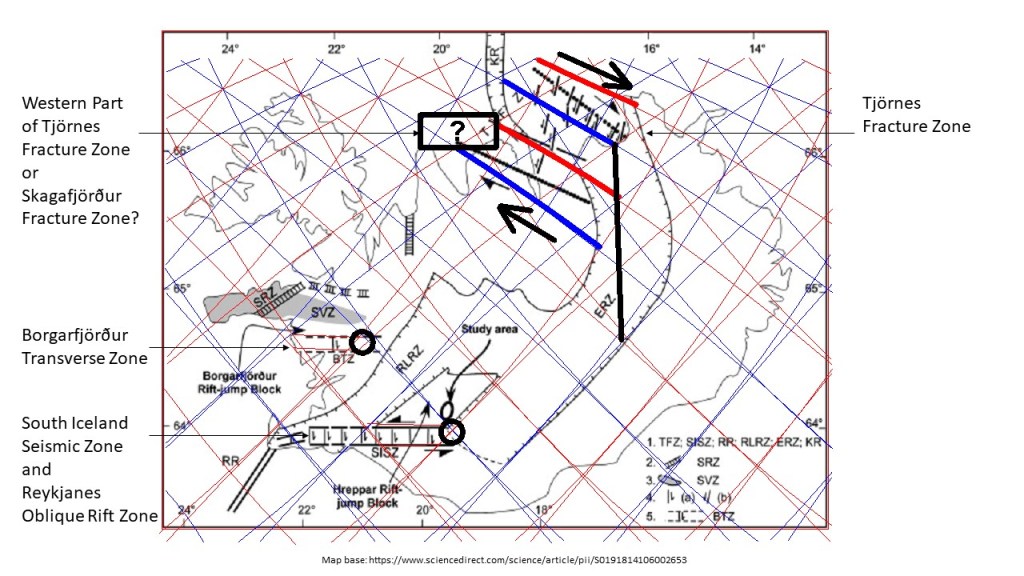
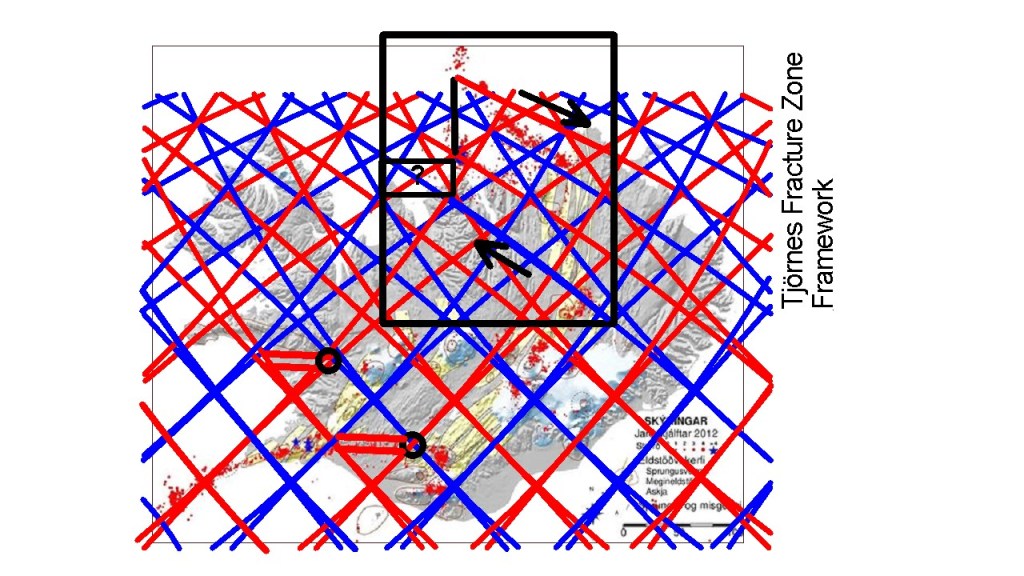
Geologists generally are aware of the connection between Reykjanes Ridge and Kolbeinsey Ridge. Here, the relevant convection roll is marked with red line for the up-welling division, and blue line for the down-welling part. By comparing with the exact location of the two ridges, the reason for the connection between them becomes clear.
The Continuity of Reykjanes Ridge and Kolbeinsey Ridge
As latitude and longitude can be easily detected on this map, the consistence between real location and this theoretic alignment can be checked out.
The cnvection roll of Reykjanes Ridge is originally connected at 120 km depth with the tectonic plate, but within the intersection zone it becomes subducted by the polar convection rolls. North of the intersection zone, the convection roll found in between the blue and red lines is also connected with the tectonic plate at 120 km depth, and it is also the upper most roll within the intersection zone.
Kolbeinsey Ridge follows a different path than Reykjanes Ridge, and seems to be a consequence of similar process as creates the volcanic zones of iceland. The Reykjanes Ridge is on the contrary directly related to a single up-welling division line.
The two ridges soutn and north of Iceland are actually of the same origin. This can be shown by comparing their location with the convection rolls model. This map shows the alignment of Kolbeinsey Ridge:
Njörður Caldera is found within the Reykjanes Ridge:
Njörður Caldera. From the book Náttúruvá á Íslandi (2013)
The Reykjanes Ridge resembles a volcanic zone, as we see in Iceland. The volcano is found at a special location, where the upper most polar convection rolls division line does approach the division line between the equatorial convection rolls, responsible for the southern half of the Reykjanes Ridge. The faults stretching northwards from the caldera enter a micropolygon, shaped by four convection rolls layers.
The location of Njörður, and mantle division lines pointed out with red lines for clarification.
The Reykjanes Ridge Polar Upper Mantle Rolls Division Line is up-welling, and works agains the drift direction of the North American Tectonic Plate, resulting in similar rifting process as within the volcanic zones of Iceland.
The Large Scale Lower Mantle Rolls are found deeper below, that is at 410 km depth. The Polar Upper Mantle Rolls upper limit is at 120 km depth, where the tectonic plate (the ductile part of it) meets with the convecting mantle.