
The Aleutian Trench extends from Alaska to Kamchatka, forming the northern segment of the Ring of Fire. Along this boundary, the Pacific Plate is subducted northwards beneath the adjacent plate.
However, the character of this subduction differs from many other regions of the Pacific. The slab appears less continuous and less regularly organized than in classic subduction zones. Within the convection rolls model, this can be explained by the direction of plate motion: northward drift causes the plate to move largely parallel to the underlying convection rolls rather than perpendicular to them. As a result, the rolls tend to deflect and segment the slab, producing divisions and irregularities.
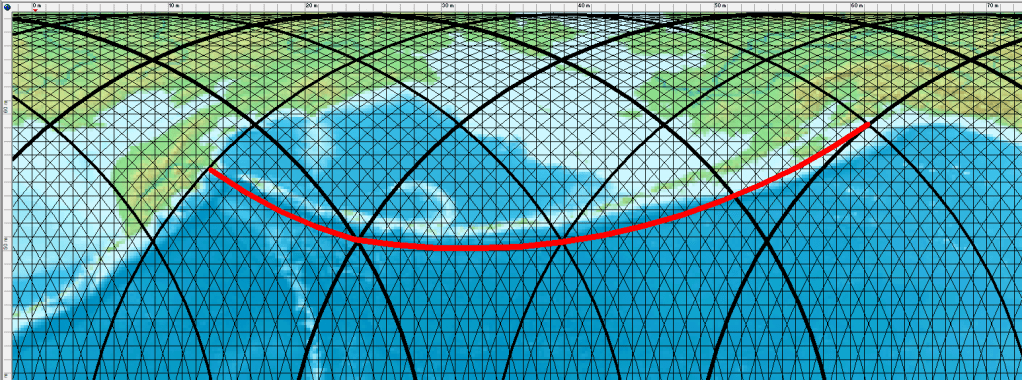
What remains remarkably consistent, however, is the position of the subduction zone itself. As seen on the model map, the Aleutian subduction zone extends between two major division lines in the lower mantle. Furthermore, its Alaskan end coincides with a crossing of two such deep-mantle structures. These intersections may act as anchoring points, helping to define the outer limits of the entire Ring of Fire.
At first glance, such consistency might be dismissed as coincidence. Yet similar patterns recur around the Pacific margin, collectively forming the well-known Ring of Fire. In the case of the Aleutian system, the subduction zone not only spans between two division lines but also aligns with additional crossings at slightly lower latitudes. These points can be interpreted as key nodes—together with corresponding structures in the upper mantle—controlling the downwelling process responsible for subduction of the Pacific Plate along approximately 51°N.
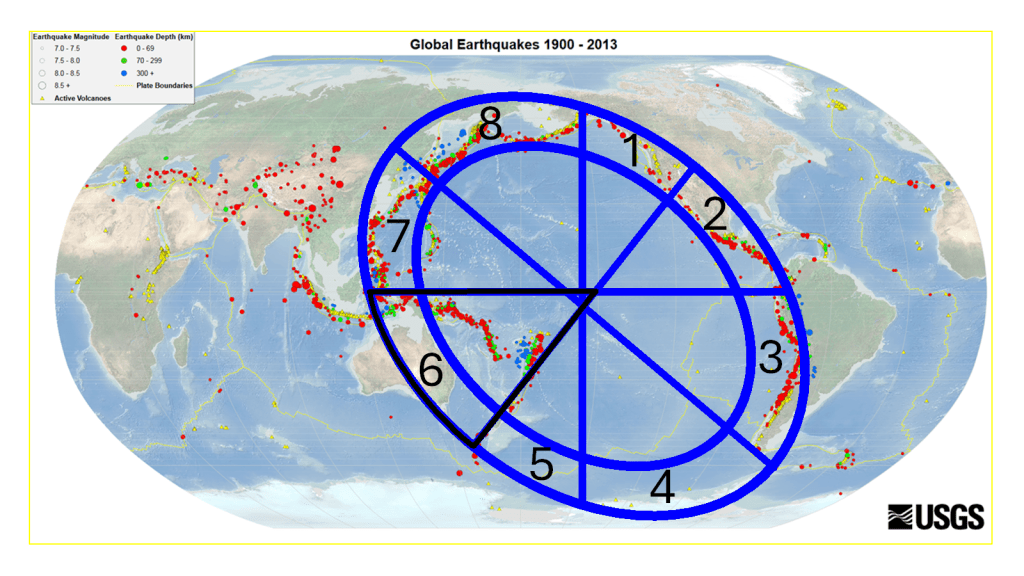
1. Alaska – Cascades 2. San Andreas – Central America 3. Eastern equatorial point – South America 4. Antarctica 5. Antarctica – New Zealand 6. New Zealand – Indonesia (western equatorial point) 7. Phillipine Sea Plate 8. Kuril Islands – Aleutian Islands.
In this framework, subduction operates in a manner comparable to regions where plates move predominantly east–west: the plate is forced to bend, descend, and penetrate into the mantle. This process is supported by convection rolls that are arranged more or less perpendicular to the direction of motion, even if only locally. Antarctica represents a further key case study within the broader Ring of Fire system. Here, the main point of interest is the striking consistency between the convection rolls model and the large-scale circular geometry observed around the Pacific margin.
The recurring geometric relationships observed around the Pacific provide a compelling basis for comparing the convection rolls model with real-world tectonic systems.
.https://en.wikipedia.org/wiki/Aleutian_subduction_zone#/media/File:EQs_1900-2016_aleutian_tsum.png

 Magic Magma
