
The 65th parallel, extending from the Snæfellsnes Volcanic Belt eastward to Snæfell and the surrounding region, is here divided into three equal segments.
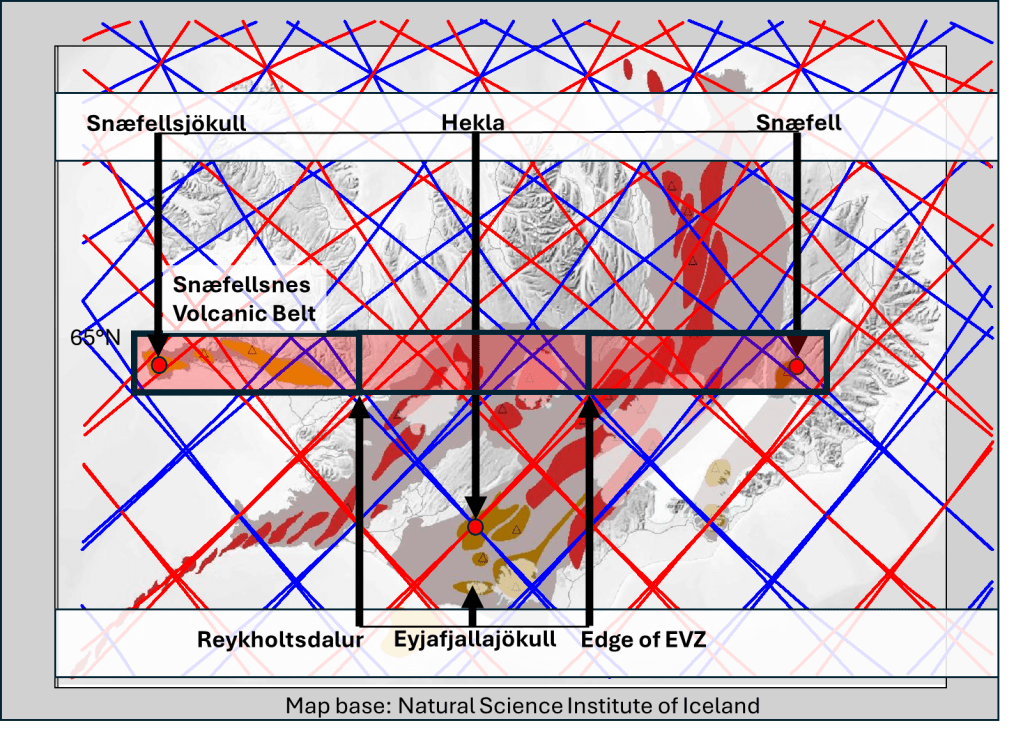
The western segment, referred to as the Snæfellsnes window, extends eastward to Reykholtsdalur, an area notable for hosting Deildartunguhver, the most powerful hot spring in the world, with a natural discharge of approximately 180 liters per second of boiling water. The second segment, equal in size, spans the region between Reykholtsdalur and the western boundary of the East Volcanic Zone. The third segment includes Snæfell and its surrounding volcanic features. Notably, this eastern window occupies a position that is geometrically mirrored relative to the Snæfellsnes window when evaluated within the defined division framework. The locations of Hekla and Eyjafjallajökull further illustrate the symmetry inherent in this configuration.
The motivation for emphasizing this observation lies in a particularly robust spatial constraint: Snæfellsjökull and Snæfell are located at exactly the same latitude. In addition, both volcanic centers are positioned at equal distances from Hekla volcano and its north–south–oriented axis. This coincidence is independent of any applied rotation and therefore represents an objective geometric relationship rather than a constructed one. Furthermore, when mirrored, both volcanic centers align with the same division-line grid, suggesting that their placement within their respective volcanic belts is not arbitrary.
Snæfell is geologically separated from the East Volcanic Zone (EVZ), as it belongs to the Öræfajökull Volcanic Belt. Nevertheless, the Snæfellsnes Volcanic Belt and the corresponding section of the EVZ are compared here as structural counterparts within this geometric framework. In addition, the Langjökull volcanic systems within the West Volcanic Zone and the Hofsjökull system within the Mid-Iceland Volcanic Belt—represented here by a single polygon—can be compared using identical window dimensions centered on the north–south axis defined by Eyjafjallajökull and Hekla.
At this latitude, five volcanic zones are intersected, all of which conform to the convection-roll division lines as outlined here. The 65th parallel is also of particular importance because it coincides with a regional transition from predominantly NE–SW-oriented volcanic and fissure systems to a primarily N–S orientation.
Although geometric similarity alone cannot establish causation, the degree of correspondence observed in this analysis supports the internal consistency of a model based on geophysically constrained layer thicknesses within the Earth and the physics of mantle convection. In particular, these observations are consistent with the hypothesis that mantle convection rolls, together with the associated regional stress-field symmetry, exert a first-order control on the spatial organization of volcanic zones in Iceland.

 Magic Magma