
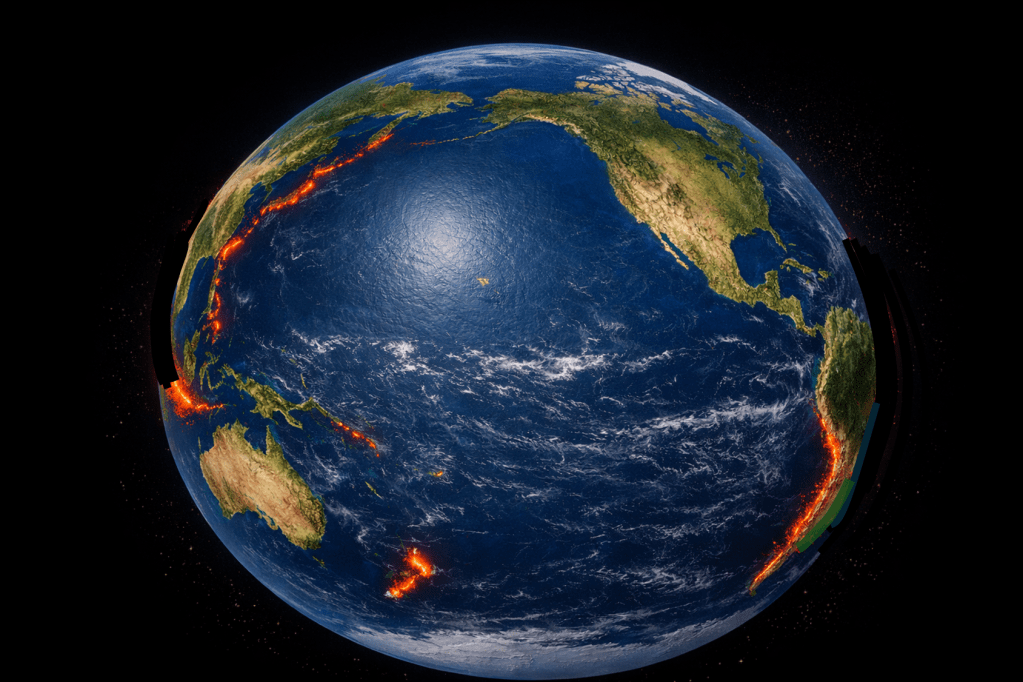
Dividing the Ring of Fire into eight approximately equal sections reveals a remarkable symmetry.
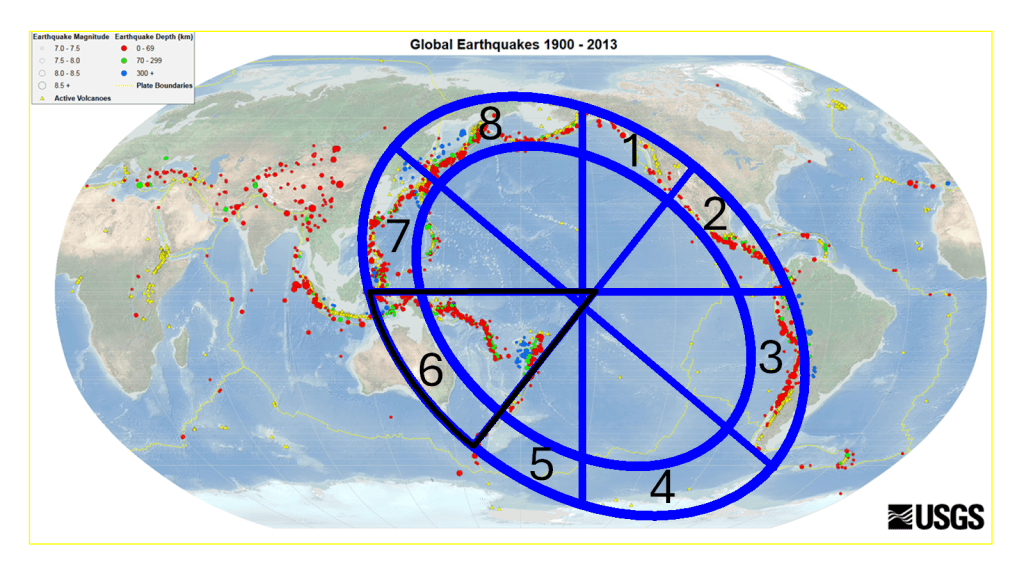
- Cascadia and western Canada, extending southward to the San Andreas Fault.
- California and the Middle America Trench.
- The Nazca Plate and the Peru–Chile Trench.
- The main volcanic region of Antarctica.
- The section containing Mount Erebus.
- An exceptional segment, where most tectonic and volcanic activity occurs inside the outer elliptical structure. This includes the Tonga–Kermadec Arc, with New Zealand located on the minor axis between sections 5 and 6.
- The Philippine Plate, where the eastern plate boundary extends beyond the inner ellipse.
- The island arcs of the Aleutian and Kuril Islands. Japan lies near the major axis, while the Hawaiian Islands extend outward from the north–south axis of the elliptical structure.
The outer ellipse is defined by connecting equatorial trench locations at the coasts of Indonesia and South America, specifically the Philippine Trench and the Peru–Chile Trench.
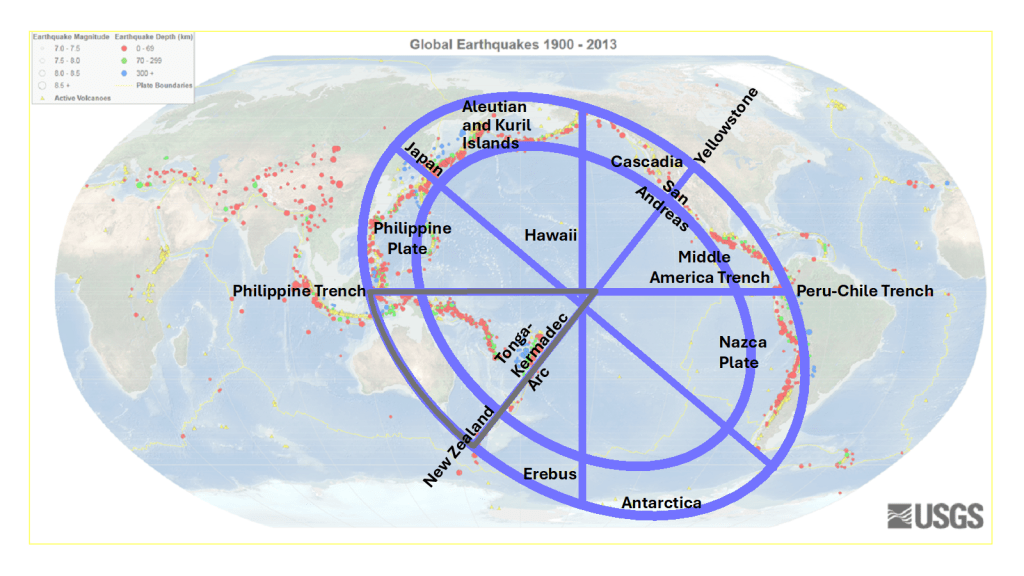
The origin of this horizontally oriented elliptical geometry is not immediately obvious; however, the San Andreas Fault represents a key constraint. Along this fault, motion is smooth and continuous where the minor axis intersects the inner ellipse, reflecting a kinematic balance between the westward drift of the North American continent and the motion of the Pacific Plate.
This geometric framework also incorporates Yellowstone, which lies at the outer intersection of the minor axis, with New Zealand forming its opposing counterpart.
Earth’s rotation is clearly a primary factor in shaping these large-scale patterns. The geometry can also be meaningfully compared with the convection-rolls model, suggesting a deeper, organized structure beneath the observed surface tectonics.
Here is my essay about the Ring of Fire for further reading:

 Magic Magma