
The Reykjanes Ridge is the most prominent geological feature of Iceland. Extrapolating its main trend along the middle of the Atlantic Ocean, it is found that most of the famous spas in Iceland are found at the edges of the two lines marking its location.

Looking into this more closely, the Blue Lagoon is found on a line perpendicular to the convection roll. Krauma of Deildartunguhver, the most powerful hot spring in the world, is found on crossings of a small polygon. The new Forest Lagoon near Akureyri is also on a perpendicular line, and the same is true for Geosea of Húsavík. At the other side of Geosea is the Myvatn Nature Baths site, and in the center of the country, Hveravellir is found near the upper convection roll extending from the north. Geysir is found just outside the realms of the roll, but on a perpendicular line. Laugarvatn is located directly ong the line, and Reykjadalur on the main crossings.
This is amazing
The eastern edge of this area can be traced most easily. From the coastline to Reykjadalur the so-called Hlíð marks its edge. But the northern ridge is shaped along a different pair of convection rolls, which happens to coincide with the Reykjanes pair at the 64th parallel. Then we get this drawing:
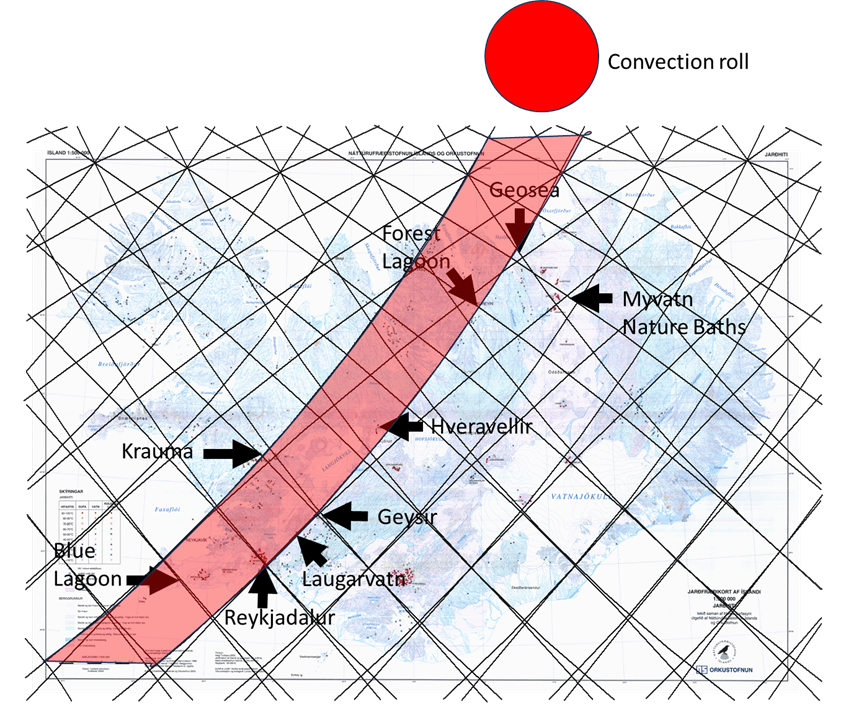
It fits even better to many of the geothermal sites, except the Myvatn Nature Baths, of course. These two pairs form the two ridges south and north of Iceland. At the latitude where the effect of those two is combined, the division line of drift shifts eastwards.
And the tenth area should be pointed out, namely Skagafjordur and the Fljot area of northern Iceland. Fissures associated with the Kolbeinsey Ridge are found on land, and that supports the idea that convection rolls creating the ridges are found at these locations underneath Iceland.
To understand better the relationship between the two ridges, and the two relevant pairs of convection rolls, one has to learn about the intersection zone of Iceland. The Reykjanes Ridge pair is the upper most one south of Iceland, but is subducted at the latitude of Iceland. The pair for Kolbeinsey Ridge is found just below the 120 km discontinuity.
This is not to be confused with subduction of the crust, as the southern convection rolls are overlaid by the northern ones around the 64th parallel. The section is shown here:
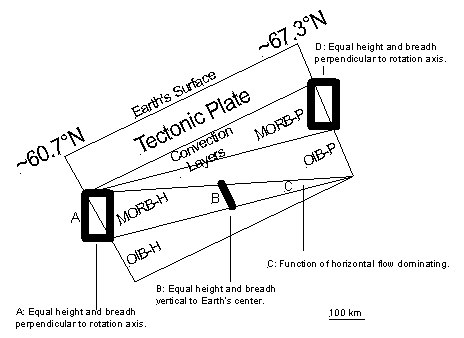
The terms, MORB-hemispheric and MORB-polar describe the Reykjanes Ridge and Kolbeinsey Ridge pairs of mantle convection rolls, respectively.

 Magic Magma