
The eruptions taking place now follow the same pattern as witnessed about half a century ago in NE Iceland. In Iceland, we talk about such a sequence of eruptions within one volcanic system as fires (eldar in Icelandic). Down below is a graph from a paper written by Páll Einarsson and Bryndís Brandsdóttir, Seismicity of the Northern Volcanic Zone of Iceland (2021):

The paper is available here: file:///C:/Users/Lenovo/Downloads/Seismicity_of_the_Northern_Volcanic_Zone_of_Icelan.pdf. Black lines indicate dyke formations and the distance from Caldera. The red vertical lines indicate eruptions in the same way. The pattern is very similar to that of the sequence of events at Sundhnjúksgígar of Reykjanes.
The settings of the Krafla volcanic system show how this works theoretically according to the mantle convection rolls model. First this drawing for orientation:

Then another drawing with the polygon enlarged:
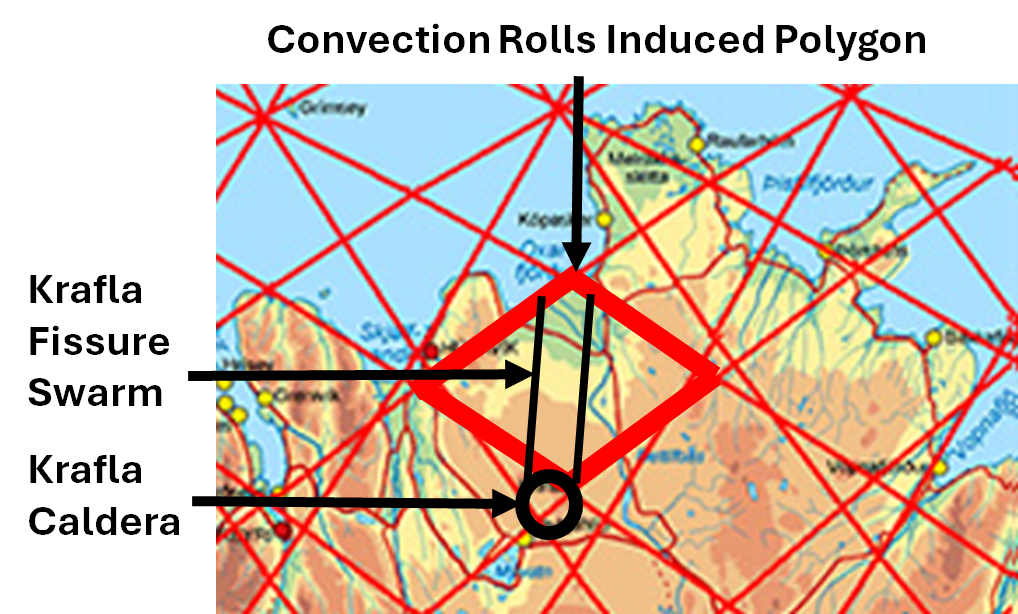
Then we can speculate about what happened there. The origin of magma was at the small polygon where the Krafla Caldera is located. The dykes did then form along the NS-axis, all the way to the northern corner of the larger polygon north of the caldera. The rifting occurs due to the fact that the North American Tectonic Plate drifts westwards, and the Eurasian plate drifts eastwards. The polygon marked with wide red lines happens to be located right in between those two plates, and consequently breaks in the middle. The combined effect of magma ascending at the southern corner within the caldera, and the tension induced by the pulling from both sides, results in events like the ones described by Páll and Bryndís.
The lines of the polygon form, according to convection rolls analysis, because two convection rolls cross each other underneath, within two different layers of convecting mantle material. Both of those can affect the surface, due to slip and no-slip effects and the Munroe Effect. Therefore, horizontal drift can take place, as rolls working the same way as the drift will become no-slip rolls, those opposing are in the slip mode. Besides, the heat radiation leads to continuos Munroe Effect process, allowing magma to ascend up through the crust at certain locations, in this case where the two layers combine their division lines in a relatively small area underneath the Krafla Caldera.
The events of Reykjanes are not described here, but there is a lot of material available to look at to compare the Krafla fires of the NE with the new Reykjanes fires of the SW of Iceland.

 Magic Magma