
For those interested in geology, waiting for a predicted eruption must be exciting. It might even divide the geological community into two different teams, one being pro-eruptive, and the other not so sure about eruption to occur for a while. Having seen seven eruptions since december 18th 2023, the process seems to be quite well known. The land has risen to a certain level and then eruption has begun. This time the same thing is happening again, land has risen to a maximal level, and eruption is logically around the corner.
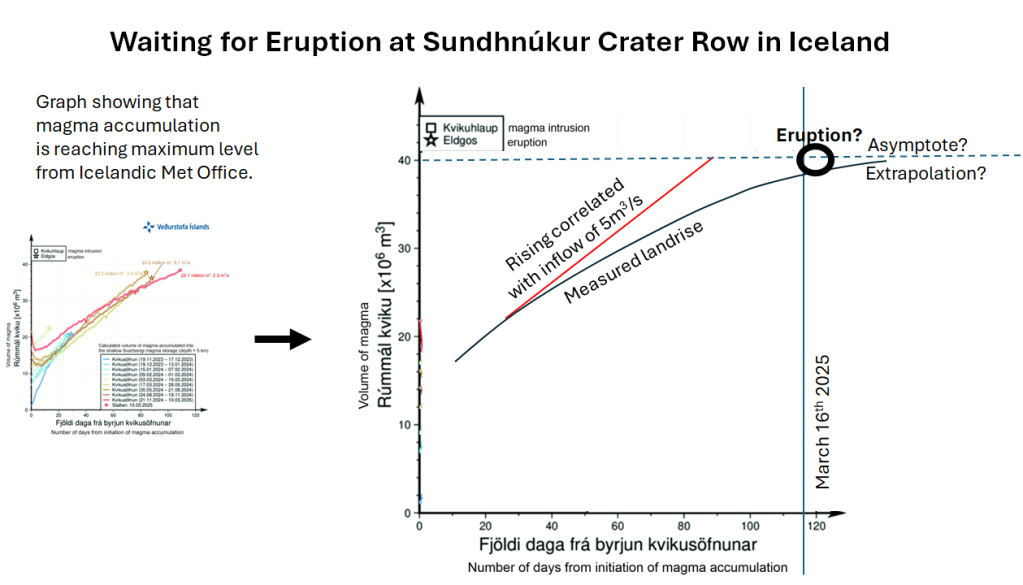
The graph from the Icelandic Meteorological Office shows how land has risen repeatedly to a similar level until an eruption was triggered. But we have other theories: 1) Some geologists are not so sure that the same story will be repeated this time. The present line showing how the surface is rising could be extrapolated to meet with an asymptote, not leading to an eruption at all, as drawn above. 2) Some say that because the accumulated magma in the reservoir responsible to the measured rising of the surface is heavier than the surrounding rock, and the bottom of the reservoir should therefore be subject to isostatic changes. The bottom of the reservoir should then be sinking, and the inflow of magma would therefore not be measured correctly, if only calculated according to the uplifting of the surface. 3) Some say that the sequence of eruption at Sunhnúkar Crater Row is over, and the next eruption will probably occur farther to the west at the so-called Eldvörp https://www.visir.is/g/20242528665d/spair-naesta-gosi-1.-mars. 4) Some say that the rifting process due to tectonic drift is temporarily over. Therefore there is not enough tension for further division, and without such an event pressure is not diminished and the volatiles will not be released within the magma in the reservoir and dyke. Therefore the eruption seems to be already overdue. Who is right?

 Magic Magma