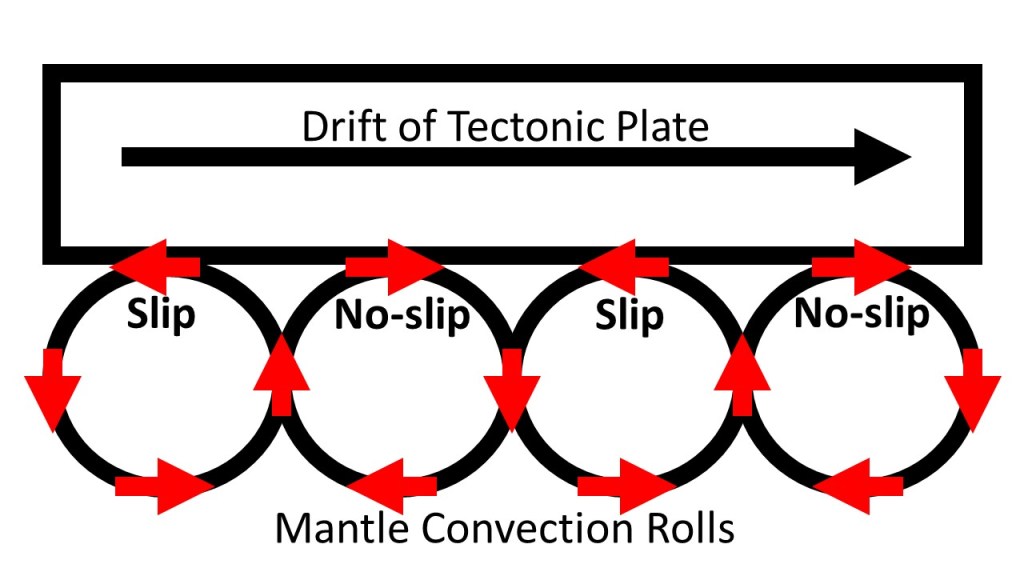
Tectonic drift has to be powered with convection currents. The currents do not work against each other due to slip and no-slip conditions. When a tectonic plate has started drifting into a certain directions, those convection rolls rolling with it also connect with it firmly, but those rolling the opposite way loose the grip. This is due to the fact that the mantle is very close to melting point, so extra friction causes melting, but less friction causes solidation.
Slip and No-slip resulting in tectonic drift.
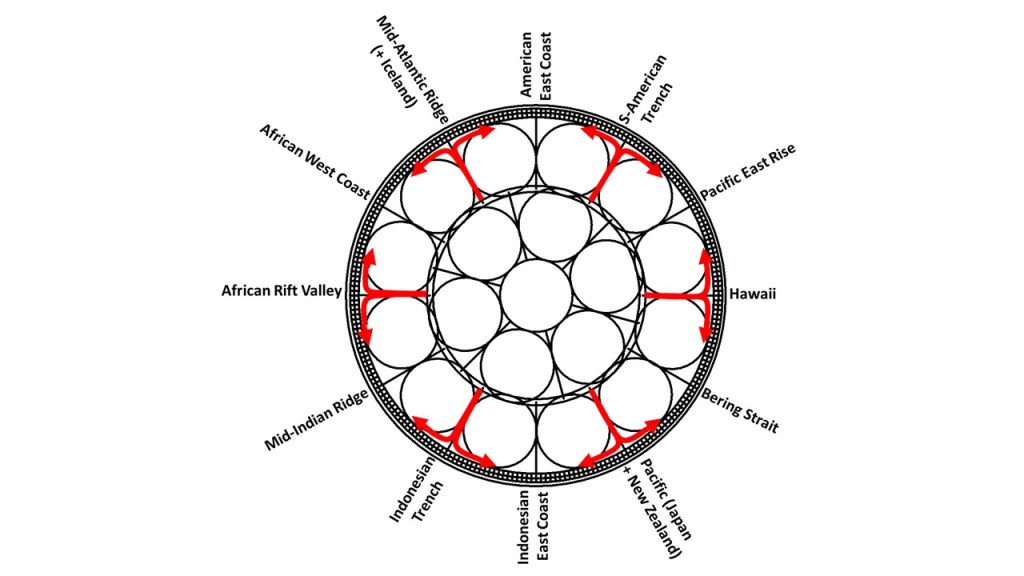
The large scale and small scale convection rolls then work together according to this picture:
Main points of main convection rolls division lines.
The small convection rolls found below the tectonic rolls therefore play a big role in inducing the tectonic drift.
I am a geologist, graduated from the University of Iceland, and taught geology for a few years. I have gained some knowledge about Earth's inner structure, so I provide this website as my contribution to answer one of the greatest questions remaining within the realm of geoscience. Experiments show that the mantle should form convection rolls when close to the melting point. I took this literally, and calculated the dimensions and shape of these mantle convection rolls. Then I compare that model with the surface. This makes it possible to provide many interesting examples about geology found on my blog.
View all posts by Steingrimur Thorbjarnarson


 Magic Magma